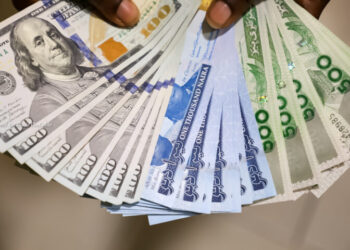
Fresh data from Nigeria’s foreign exchange market is flashing a warning sign: offshore investors are stepping back, and dollar inflows are feeling the strain. Despite sustained efforts by the Central Bank of Nigeria (CBN) to steady the naira, total dollar inflows into the official market dropped sharply last week, underscoring lingering concerns about investor confidence.
According to a research note by Coronation Merchant Bank, inflows into the Nigeria Foreign Exchange Market (NFEM) fell by about 21% week on week, sliding to $593.7 million from $748.4 million in the prior period. The pullback was driven largely by a steep decline in foreign capital, even as domestic sources stepped in to keep the market liquid.
The most pronounced weakness came from overseas investors. Foreign portfolio investment collapsed by nearly 73%, falling to $46 million, while foreign direct investment sank by more than 80% to just $7 million. Together, foreign inflows accounted for only 17% of total FX supply, highlighting the depth of caution among global investors despite recent reforms aimed at liberalising and improving transparency in the FX market.
With offshore flows thinning out, local sources carried the bulk of the market. Domestic participants supplied almost 83% of total inflows, led by individuals, exporters and importers, alongside sizeable dollar sales from the CBN. Analysts note that this growing dependence on local liquidity and central bank intervention points to an FX market still struggling to attract sustainable foreign capital.
The naira’s performance reflected this mixed backdrop. At the official window, the currency edged stronger, supported by ongoing CBN intervention, closing the week around N1,431 to the dollar. In contrast, the parallel market told a different story, with the naira weakening toward N1,490, a sign that unmet demand persists outside the formal trading system.
External reserves offered some relief, inching higher at the start of the year to around $45.5 billion, even as the CBN continues to deploy dollars to defend the currency. The introduction of electronic trading platforms, including the Bloomberg-powered FX matching system and the CBN’s own electronic matching infrastructure, has helped improve price discovery and narrow gaps between official and street rates. Still, analysts caution that these tools alone cannot compensate for weak autonomous inflows.
Looking ahead, economists expect the naira to remain relatively stable in the near term at the official market, buoyed by intervention and easing seasonal demand. Over the course of 2026, projections place the currency within a N1,400–N1,500 per dollar range, assuming stronger oil output and improved export earnings.
However, the message from the latest data is clear: lasting stability in Nigeria’s FX market will hinge less on central bank support and more on restoring investor confidence. Without consistent policies, fiscal discipline and a market framework that can attract long-term foreign capital, analysts warn that current calm could prove fragile.