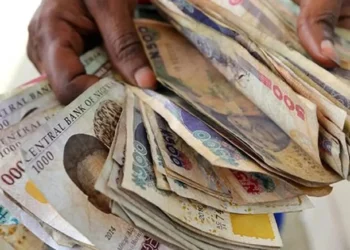
On June 2, 2025, the Nigerian Naira displayed divergent trends in May, gaining 1.28% in the official market to close at N1,585.50/$1 on May 30 from N1,606/$1 on May 2, but losing 1.24% in the parallel market, ending at N1,630/$1 from N1,610/$1, according to Research team. At the current exchange rate of N1,579/$1 as of June 2, 2025, the official market’s stability contrasts with parallel market volatility. The Naira’s official market performance included a low of N1,612/$1 on May 7, but it stabilized between N1,579/$1 and N1,592/$1 from May 23 to 30, reflecting Central Bank of Nigeria (CBN) interventions and improved external balances.
In the parallel market, the Naira hit a monthly low of N1,635/$1 on May 15, but traded steadily between N1,618/$1 and N1,625/$1 from May 21 to 29. Against other currencies, the Naira weakened to N2,190/£1 from N2,142/£1 and N1,835/€1 from N1,820/€1 by month-end. The OPEC+ decision to increase oil production by 411,000 barrels per day in July 2025 threatens Nigeria’s forex earnings, as potential oil price declines could exacerbate Naira pressure, given oil’s 90% share of export revenue.
The CBN’s 300th Monetary Policy Committee meeting on May 19–20 retained the Monetary Policy Rate at 27.5%, Cash Reserve Ratio at 50% for commercial banks (16% for merchant banks), and Liquidity Ratio at 30%, aiming to curb inflation, which remains high despite easing. Dr. Muda Yusuf of the CPPE criticized the 50% CRR as excessive, urging balanced monetary tools. Posts on X, like @Nairametrics, highlight concerns over oil-driven forex risks, while @thecableng notes CBN’s stabilizing efforts, though the AfDB’s 6% depreciation forecast for 2026 looms.