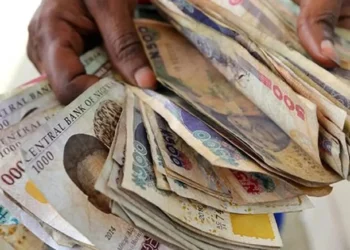
Nigeria’s naira posted a robust 4.31% appreciation against the US dollar in February 2026, defying Central Bank of Nigeria (CBN) efforts to temper excessive strengthening through aggressive dollar purchases late in the month.
According to the Financial Markets Dealers Association (FMDA) monthly report released on March 3, 2026, the currency firmed across both the Nigerian Foreign Exchange Market (NFEM) and the parallel market, even as the apex bank absorbed significant foreign exchange liquidity to prevent rapid appreciation that could disrupt investor positioning in local fixed-income securities.
The FMDA noted: “Despite the CBN’s late-month FX purchases to prevent excessive naira strengthening that could distort investor positioning, the currency still appreciated across both the NFEM and parallel markets.” The intervention followed a period when the naira had approached levels between N1,400 and N1,500 per dollar, prompting concerns over potential reversals in capital flows attracted by high yields on domestic instruments.
The resilience came amid improved external buffers and favourable global oil dynamics. Brent crude prices hovered around $80 per barrel, supported by escalating tensions between the United States and Iran. FMDA analysts highlighted that “crude oil prices will continue to offer a buffer for the naira as tensions escalate between the US and Iran.” A disruption in the Strait of Hormuz—through which roughly 25% of global seaborne oil trade passes—could push prices toward $120–$150 per barrel, significantly boosting Nigeria’s export earnings and foreign exchange inflows.
Muda Yusuf, founder of the Centre for the Promotion of Private Enterprise, acknowledged the positive impact of higher oil prices on dollar supply and currency stability but cautioned about secondary effects. “Rising global energy costs could further squeeze households already grappling with elevated prices,” he warned, noting the potential inflationary pass-through from imported goods.
Nigeria’s gross external reserves stood at $49.69 billion as of February 27, 2026, while net reserves expanded dramatically up 772.18% over two years to $34.80 billion by the end of 2025, compared with $3.99 billion in 2023. The improvement reflects better FX management, increased oil receipts, and reduced reliance on deficit financing.
Despite the monthly gain, short-term pressures persisted. On Tuesday, March 3, the naira slipped N6.27 (0.5%) to close at N1,384.29 per dollar in the NFEM, compared with N1,378.02 the previous day. The parallel market also weakened slightly, ending at N1,380 per dollar from N1,375.
The February performance signals continued confidence in Nigeria’s external position and monetary framework, bolstered by rising reserves and elevated crude prices. However, analysts caution that sustained geopolitical risks in the Middle East could introduce volatility, while domestic inflation and import costs remain key vulnerabilities. Market participants will closely monitor oil price trends, CBN liquidity management, and any escalation in global tensions for directional cues in the weeks ahead.