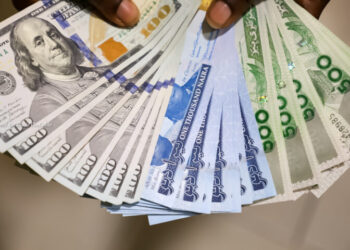
The Nigerian naira delivered its strongest official-market performance in nearly two years on Tuesday, closing at N1,358.91 per US dollar a gain of N17.45 (1.3%) from Monday’s N1,390.36 without any reported intervention from the Central Bank of Nigeria (CBN).
The rally extended the currency’s recent upward trend, with intraday trading briefly pushing the rate as low as N1,350 before settling near N1,359. The appreciation reflects a combination of improved FX liquidity, steady inflows, and a notably absent CBN footprint in the session.
In the parallel (black) market, the naira held firm at N1,450 per dollar, narrowing the official–parallel premium to N77.09 one of the tightest gaps seen in recent months and a sign of better supply visibility across market segments.
Coronation Securities Limited data show foreign portfolio investment (FPI) inflows remained robust, with fixed-income assets accounting for $0.31 billion — nearly half of total portfolio flows. Equity inflows were modest at $0.01 billion (1.16%), and foreign direct investment contributed $0.03 billion (4.72%). Domestic non-official FX supply was led by exporters and importers ($0.14 billion, 21.67% of total inflows), with individuals and non-bank corporates also playing a role.
Nigeria’s external reserves continued their climb, reaching $46.59 billion as of February 2, 2026, according to market sources. Analysts at Rhodium Capital Limited attributed the naira’s strength to rising reserves, improved FX supply dynamics, and a weaker US dollar globally, which has enhanced liquidity and reduced pressure on emerging-market currencies.
The narrowing official–parallel gap suggests progress in market alignment, reduced arbitrage opportunities, and greater confidence in the official FX window. The CBN’s hands-off approach during the session reinforces the shift toward a more market-determined exchange-rate regime, supported by ongoing reforms such as the Electronic Foreign Exchange Matching System and increased transparency.
The naira’s performance in early 2026 builds on gains made in 2025 and offers relief to importers, manufacturers, and households facing FX needs for goods, education, healthcare, and raw materials. A firmer currency also helps contain imported inflation and supports the CBN’s goal of price and exchange-rate stability.
While the current momentum is encouraging, analysts caution that sustainability will depend on continued inflows from oil, remittances, and portfolio investments, as well as disciplined fiscal and monetary management. With reserves now firmly above $46 billion, the CBN retains ample room to manage volatility should demand pressures re-emerge.
For now, the naira’s Tuesday close at N1,358.91 per dollar marks a significant milestone the strongest official rate since mid-2024 and signals growing stability in Nigeria’s FX landscape. Market participants will watch whether the currency can hold or build on these gains as February progresses.