Nigeria’s gross external reserves have climbed to $46.11 billion as of January 28, 2026 — the highest level recorded in eight years providing the economy with a robust buffer equivalent to about 14 months of import cover and strengthening the naira’s recent gains.
The figure represents an 18.6% increase from $38.88 billion a year earlier, driven by a combination of higher oil export earnings, surging diaspora remittances, and renewed inflows from foreign portfolio investors.
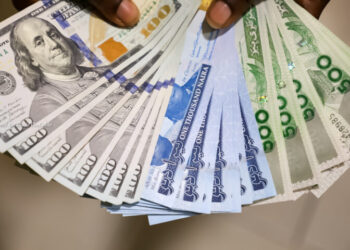
Bismark Rewane, Managing Director of Financial Derivatives Company Limited, noted that the reserve build-up has directly eased pressure on the naira, which appreciated by 0.65% to N1,385 per dollar — its strongest level since May 2024, when it traded at N1,329.65.
The stronger reserves reduce exchange-rate pass-through to inflation, helping stabilise input costs for small and medium-sized enterprises and supporting household purchasing power as the country approaches a pre-election year.
Rewane attributed the positive momentum to ongoing Central Bank of Nigeria (CBN) reforms under Governor Olayemi Cardoso, which have restored investor confidence and improved foreign exchange liquidity. He estimated the naira’s fair value at approximately N1,257 per dollar under purchasing power parity (PPP), suggesting the currency remains undervalued by about 11%.
Aminu Gwadabe, President of the Association of Bureau De Change Operators of Nigeria (ABCON), described the naira as enjoying “relative stability” across markets, ending years of turbulence. Dr. Muda Yusuf, CEO of the Centre for the Promotion of Public Enterprise (CPPE), expressed optimism that continued forex and fiscal reforms would sustain reserve growth, even as oil remains a key driver. Yusuf highlighted the increasing contribution of foreign direct investment, portfolio flows, and non-oil exports to the reserves.
The CBN has projected that external reserves could reach $51.04 billion in 2026, supported by healthier oil revenues, sustained reforms, and improved external inflows. The planned ramp-up of the Dangote Refinery’s capacity is also expected to reduce Nigeria’s dependence on imported petroleum products, further strengthening the balance of payments.
However, analysts caution that maintaining the upward trajectory in an election year will require discipline. Excessive foreign exchange interventions, uncontrolled government spending, or policy uncertainty could trigger FX demand spikes and capital flow reversals — risks historically associated with pre-election periods in Nigeria.
For now, the $46.11 billion milestone signals a more resilient external position than the country has seen in nearly a decade, offering policymakers greater room to manage volatility and support economic stability. Investors and businesses will be watching closely to see whether the momentum can be sustained through 2026.