RateCaptain
  • Home
    • About Us
    • Contact Us
  • FX Rates
  • Money Market
  • Cryptocurrency
  • Commodities
  • Corporates
No Result
View All Result
Subscribe
  • Home
    • About Us
    • Contact Us
  • FX Rates
  • Money Market
  • Cryptocurrency
  • Commodities
  • Corporates
No Result
View All Result
RateCaptain
No Result
View All Result
Home Economy

Nigeria’s Oil Production Was OPEC’s Biggest Increase in March – Reuters

Rate Captain by Rate Captain
April 3, 2023
in Economy
Reading Time: 3 mins read
A A
0
Nigeria’s Oil Production Was OPEC’s Biggest Increase in March – Reuters
Share on FacebookShare on TwitterShare on WhatsappShare on Telegram

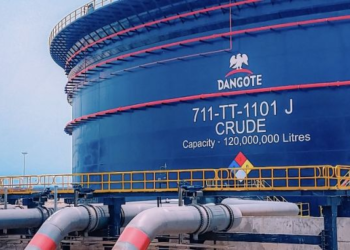
Nigeria’s crude oil production for March 2023 edged up to about 1.6 million barrels per day (mbpd), with the country recording the biggest Organisation of Petroleum Exporting Countries’ (OPEC) biggest increase last month, a survey by Reuters has revealed.

At about 1.6 million, the country was able to meet the federal government’s target for the first quarter of 2023, the survey conducted by Reuters for March disclosed. The latest production performance contributed significantly to the 28.90 mbpd pumped by OPEC.
Minister of Finance, Budget, and National Planning, Mrs. Zainab Ahmed had in December 2022, said at the World Bank’s Nigeria Development Update and Country Economic Memorandum in Abuja, that the government set its sight on Nigeria’s crude oil production reaching 1.6mbpd by the first quarter of 2023.

AlsoRead

National Grid Collapses Again, Plunging Nigeria into Nationwide Blackout

US Records $1.45 Billion Trade Surplus with Nigeria in First 10 Months of 2025 as Exports Surge 60%

LIRS Warns Banks, Employers and Others: We’ll Deduct Unpaid Taxes Directly from Your Funds

Ahmed hinged the government’s expectation on efforts made by stakeholders to improve oil production infrastructure and reduce oil theft.

Nigeria’s oil output as published by the Nigerian Upstream Petroleum Regulatory Commission (NUPRC) was 1.25mbpd in January and 1.3mbpd in February, but the volume produced for March came close to 1.6mbp.

The Nigerian National Petroleum Company Limited (NNPC) had on several occasions disclosed that Nigeria’s oil production had climbed to 1.6mbpd, with the first of such disclosures coming early December 2022 from the Chief Investment Officer of the NNPC Upstream Investment Management Services (NUIMS), Mr. Bala Wunti, at an industry event in Uyo, Akwa Ibom State.

Also in February, at a meeting of stakeholders in the oil and gas industry in Abuja, the Group Chief Executive Officer of NNPC, Mallam Mele Kyari, had confirmed that the country’s oil production had risen to 1.67 million barrels per day, some millions short of the 1.8 million bpd quota allocated to Nigeria by OPEC.

Kyari had said the ‘rectangular’ security approach employed by the company was already working, adding that implementation of the ‘Detect, Deter, Destroy’ and Recover (3D strategy) has been a game changer in the fight against crude oil theft and vandalism.

The Reuters survey tracked supply to the market based on shipping data provided by external sources, Refinitiv Eikon flows data, information from companies that track flows such as Petro-Logistics and Kpler, and information provided by sources at oil companies, OPEC, and consultants.

The survey established that the increased output level by Nigeria, Africa’s largest oil and gas producer was recorded, despite a 70,000 bpd drop in the OPEC oil output in March, which was attributed to oilfield maintenance in Angola and a halt in some of Iraq’s exports.

Further revelation showed that OPEC’s output was down more than 700,000 bpd from September, and 70,000 bpd from February 2023 output level.
The largest drop of 100,000 bpd was in Angola and was due to a small export programme and field maintenance on the Dalia stream, resulting to exports hitting a multi-month low on some estimates.

The second-biggest drop came from Iraq, where companies have reduced output in the northern Kurdistan region following a halt to the export pipeline penultimate weekend.

Higher exports from southern Iraq limited the decline, the survey found, adding that OPEC’s output was significantly undershooting the targeted amount by 930,000 bpd because many producers – notably Nigeria and Angola – lack the capacity to pump at the agreed levels.
OPEC’s Gulf producers, Saudi Arabia, Kuwait and the United Arab Emirates maintained high compliance with their targets under the OPEC+ agreement, the survey revealed.

Meanwhile, a petroleum expert and Publisher of Oil+Gas Report, Mr. Toyin Akinosho has advised the incoming administration to as a matter of priority emplace an independent and powerful regulator for the Nigerian oil and gas industry, especially the upstream subsector in order to ensure compliance to operational rules as well as to increase foreign exchange earnings to the country.

Akinosho added that such regulator whether it is the NUPRC or the Nigerian Midstream and Downstream Petroleum Regulatory Authority (NMDPRA) should be made to possess the same kind of powers and independence like the Central Bank of Nigeria (CBN) and the Nigerian Communications Commission (NCC) to be able to regulate the oil sector well without undue interference by external forces.

In an exclusive chat with THISDAY, Akinosho explained that robust regulation was needed in the oil and gas industry to ensure that operating companies operate in accordance with the rules.

He said such regulator must be able to take decisions without undue influence from the minister as obtained in the CBN and the NCC in their running of the banking and telecoms sectors, respectively.

“For me, it’s just that one word that we say every time -regulation, we need an independent regulator who does not look behind his back. Just regulate all these companies properly, let people operate how they should, let there be openness. In everything that they do, let it be fair.

“Once you get a regulator that works, every other thing will follow accordingly. The thing is, if the regulator is weak, which the defunct Department of Petroleum Resources (DPR) was, because the DPR was some kind of an agent of the minister and when a certain DPR regulator had the powers to do a bid round, you saw what he did,” Akinosho said.
He maintained that regulator was very key, pointing out that all the evacuation issues Nigeria had that led to rampant crude oil theft was a function of regulation and the kind of regulator in place.

Previous Post

Calabar Port on course for economic prosperity- Port Manager

Next Post

Oando to become private firm as core investor offers buyout of minority shareholders.

Related News

 Top Story: Central Bank Raises MPR by 200 Basis Points to 24.75%

National Grid Collapses Again, Plunging Nigeria into Nationwide Blackout

by Victoria Attah
January 27, 2026
0

Nigeria’s electricity grid has suffered another total system collapse, marking the second major failure in 2026 and leaving the entire...

US Records $1.45 Billion Trade Surplus with Nigeria in First 10 Months of 2025 as Exports Surge 60%

by Jide Omodele
January 27, 2026
0

The United States posted a $1.45 billion goods trade surplus with Nigeria in the first ten months of 2025  a...

LIRS Shuts 34 Companies Over Tax Non-Compliance

LIRS Warns Banks, Employers and Others: We’ll Deduct Unpaid Taxes Directly from Your Funds

by Stephen Akudike
January 26, 2026
0

The Lagos State Internal Revenue Service (LIRS) has issued a strong public warning that it will begin using its legal...

$26 Billion for unidentified source passed through Binance-Cardoso

CBN Auctions N1.15 Trillion in Treasury Bills as Investors Eye Higher Yields

by Stephen Akudike
January 22, 2026
0

The Central Bank of Nigeria (CBN) is set to conduct its second Treasury bills auction of 2026 today, offering instruments...

Next Post
Oando to become private firm as core investor offers buyout of minority shareholders.

Oando to become private firm as core investor offers buyout of minority shareholders.

Leave a Reply Cancel reply

Your email address will not be published. Required fields are marked *

Recommended

2024 Budget Outline: Oil Price Set at $77.96, Naira Stands at 750 Against the Dollar

Nigeria and UAE Sign Landmark Trade Deal to Eliminate Tariffs on Thousands of Products

January 27, 2026
 Top Story: Central Bank Raises MPR by 200 Basis Points to 24.75%

National Grid Collapses Again, Plunging Nigeria into Nationwide Blackout

January 27, 2026

Popular Story

  • 2024 Budget Outline: Oil Price Set at $77.96, Naira Stands at 750 Against the Dollar

    Nigeria and UAE Sign Landmark Trade Deal to Eliminate Tariffs on Thousands of Products

    0 shares
    Share 0 Tweet 0
  • Dangote Refinery Suspends Petrol Sales and Cancels Contracts as Crude Supply Issues Bite

    0 shares
    Share 0 Tweet 0
  • US Records $1.45 Billion Trade Surplus with Nigeria in First 10 Months of 2025 as Exports Surge 60%

    0 shares
    Share 0 Tweet 0
  • Nigeria Customs Service Surpasses N7.2 Trillion Revenue Target in 2025

    0 shares
    Share 0 Tweet 0
  • National Grid Collapses Again, Plunging Nigeria into Nationwide Blackout

    0 shares
    Share 0 Tweet 0
RateCaptain

RateCaptain

We bring you the most accurate in new and market data. Check our landing page for details.

  • Home
  • About Us
  • Privacy Policy
  • Terms & Conditions
  • Disclaimer
  • Cookie Policy
  • Contact Us

Copyright © 2022 RateCaptain - All rights reserved by RateCaptain.

No Result
View All Result
  • Home
    • About Us
    • Contact Us
  • FX Rates
  • Money Market
  • Cryptocurrency
  • Commodities
  • Corporates

Copyright © 2022 RateCaptain - All rights reserved by RateCaptain.

RateCaptain
Manage Cookie Consent
To provide the best experiences, we use technologies like cookies to store and/or access device information. Consenting to these technologies will allow us to process data such as browsing behavior or unique IDs on this site. Not consenting or withdrawing consent, may adversely affect certain features and functions.
Functional Always active
The technical storage or access is strictly necessary for the legitimate purpose of enabling the use of a specific service explicitly requested by the subscriber or user, or for the sole purpose of carrying out the transmission of a communication over an electronic communications network.
Preferences
The technical storage or access is necessary for the legitimate purpose of storing preferences that are not requested by the subscriber or user.
Statistics
The technical storage or access that is used exclusively for statistical purposes. The technical storage or access that is used exclusively for anonymous statistical purposes. Without a subpoena, voluntary compliance on the part of your Internet Service Provider, or additional records from a third party, information stored or retrieved for this purpose alone cannot usually be used to identify you.
Marketing
The technical storage or access is required to create user profiles to send advertising, or to track the user on a website or across several websites for similar marketing purposes.
  • Manage options
  • Manage services
  • Manage {vendor_count} vendors
  • Read more about these purposes
View preferences
  • {title}
  • {title}
  • {title}
?>