RateCaptain
  • Home
    • About Us
    • Contact Us
  • FX Rates
  • Money Market
  • Cryptocurrency
  • Commodities
  • Corporates
No Result
View All Result
Subscribe
  • Home
    • About Us
    • Contact Us
  • FX Rates
  • Money Market
  • Cryptocurrency
  • Commodities
  • Corporates
No Result
View All Result
RateCaptain
No Result
View All Result
Home Economics

A $9 Trillion Binge Turns Central Banks Into the Market’s Biggest Whales

Rate Captain by Rate Captain
September 8, 2021
in Economics
Reading Time: 4 mins read
A A
0
Share on FacebookShare on TwitterShare on WhatsappShare on Telegram

AlsoRead

Nigeria’s Inflation Eases to 20.12% in August, Prompting Calls for CBN Rate Cuts

African Nations Grapple with Soaring Borrowing Costs in 2025 Amid Inflation Surge

CBN Holds Policy Rates Steady Amid Global Economic Challenges

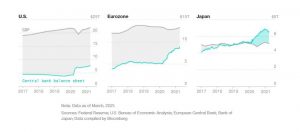
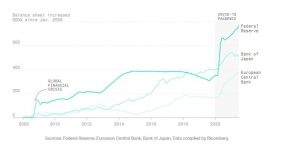
Since the start of the pandemic, central banks in the U.S., Europe and Japan have been on a $9 trillion spending spree.

That binge has turned the U.S. Federal Reserve, the European Central Bank and the Bank of Japan into the ultimate market whales, swelling their combined assets to $24 trillion. Now, talk is shifting to winding down the banks’ massive monetary stimulus and the challenge that presents for the economies they support.

So where has all the central banks’ money gone?

They bought a lot of bonds, of course, helping their governments fund stimulus programs.

The Fed bought a higher proportion of mortgage-backed securities than its counterparts, desperate to shore up a sector that caused so much trouble during the global financial crisis of 2008. In fact, it spent enough on these assets to buy more than a million homes in New York. Some Fed officials think that mortgage-backed securities are where spending should slow first.

The ECB and BOJ did more with loans, keeping businesses afloat, workers in jobs and preventing bad debts from piling up at banks. Indeed, the Japanese central bank’s extra lending would cover the debts of every company that has gone out of business in the country since the autumn of 2003.

What do the central banks actually “owe?”

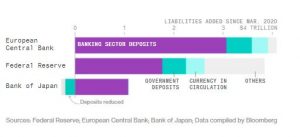
Central banks follow basic accounting rules, just like the rest of us, so all those trillions of dollars in assets have liabilities to match. During the pandemic, a lot of that has ended up as bank deposits, keeping lenders flush with liquidity. Getting that money pumping through the economy will be key to sustaining the recovery as central banks dial back stimulus. Government deposits and currency in circulation have also climbed in Europe and the U.S.

Has the binge really helped the economy, or just asset prices?

Clearly, the global economy would be in a worse position now if central banks hadn’t jumped in to help avert a financial crisis. And governments wouldn’t have been able to fund their health and welfare spending without the help of central banks.

But it’s also clear that many asset classes such as technology stocks and real estate—and the people who own them—have fared better than the average worker over the past year or so. The Fed has the best data illustrating how the rich got richer and the poor slipped even further behind.

Is there a limit to how long this binge can continue?

No one really knows. Some worry inflation will spike because of all the cash injected into the economy. Others are concerned about the outsized influence of central banks in free markets—the BOJ for instance owns almost half of all the outstanding Japanese government bonds.

Japan has been buying bonds for decades and its balance sheet is now larger than the economy. The Fed and ECB would need to keep buying at their current clip for years to approach that level, suggesting they may not be out of policy room yet.

So what comes next?

The Fed last month said it will begin a discussion about reducing the scale of its purchases — a process known as “tapering.” Since then, a flurry of Fed officials have spoken publicly about when and how purchases may slow, perhaps in the hope that financial markets will become accustomed to the idea.

The BOJ is spending less on exchange-traded funds. But it has pledged to keep buying bonds for as long as needed to revive inflation, which remains a long way below target. The ECB has promised to keep splashing the cash too, wary of criticism it pulled back too early after the last crisis.

For now, the trio are still spending hundreds of billions of dollars each month to support the post-pandemic recovery. And while slowing the rate of purchases may be on the horizon, especially for the U.S., reversing course and actually selling securities remains a distant proposition. Weaning the world off such huge doses of stimulus will shape the economic and market landscape for years to come.

Previous Post

Investment Banks Turn Sour on U.S. Equity Outlook

Next Post

PayPal to acquire buy now pay later firm Paidy in $2.7B deal

Related News

Nigeria’s Inflation Eases to 20.12% in August, Prompting Calls for CBN Rate Cuts

by Stephen Akudike
September 16, 2025
0

Nigeria’s headline inflation rate dropped to 20.12% in August 2025, marking its fifth consecutive month of decline from 21.88% in...

IMF Lists Top 10 African Nations with Highest Debt Burdens

African Nations Grapple with Soaring Borrowing Costs in 2025 Amid Inflation Surge

by Akpan Edidong
August 6, 2025
0

Across Africa, central banks are wielding high Monetary Policy Rates (MPRs) as a weapon against persistent inflation, currency volatility, and...

NEC Affirms CBN $3 Billion Loan for Naira Stability

CBN Holds Policy Rates Steady Amid Global Economic Challenges

by Stephen Akudike
July 31, 2025
0

The Central Bank of Nigeria (CBN) maintained its key monetary policy instruments at the July 2025 Monetary Policy Committee (MPC)...

Nigeria and UK Set to Sign Enhanced Trade Investment Partnership Agreement

UK-Nigeria Standards Partnership Boosts Nigerian Exports with Zero Tariffs for 3,500 Products

by Akpan Edidong
July 25, 2025
0

Nigeria’s export sector received a significant lift with the launch of the third phase of the UK-Nigeria Standards Partnership Programme,...


Next Post

PayPal to acquire buy now pay later firm Paidy in $2.7B deal

Leave a Reply Cancel reply

Your email address will not be published. Required fields are marked *

Recommended

2024 Budget Outline: Oil Price Set at $77.96, Naira Stands at 750 Against the Dollar

Nigeria and UAE Sign Landmark Trade Deal to Eliminate Tariffs on Thousands of Products

January 27, 2026
 Top Story: Central Bank Raises MPR by 200 Basis Points to 24.75%

National Grid Collapses Again, Plunging Nigeria into Nationwide Blackout

January 27, 2026

Popular Story

  • 2024 Budget Outline: Oil Price Set at $77.96, Naira Stands at 750 Against the Dollar

    Nigeria and UAE Sign Landmark Trade Deal to Eliminate Tariffs on Thousands of Products

    0 shares
    Share 0 Tweet 0
  • US Records $1.45 Billion Trade Surplus with Nigeria in First 10 Months of 2025 as Exports Surge 60%

    0 shares
    Share 0 Tweet 0
  • Dangote Refinery Suspends Petrol Sales and Cancels Contracts as Crude Supply Issues Bite

    0 shares
    Share 0 Tweet 0
  • Nigeria Customs Service Surpasses N7.2 Trillion Revenue Target in 2025

    0 shares
    Share 0 Tweet 0
  • National Grid Collapses Again, Plunging Nigeria into Nationwide Blackout

    0 shares
    Share 0 Tweet 0
RateCaptain

RateCaptain

We bring you the most accurate in new and market data. Check our landing page for details.

  • Home
  • About Us
  • Privacy Policy
  • Terms & Conditions
  • Disclaimer
  • Cookie Policy
  • Contact Us

Copyright © 2022 RateCaptain - All rights reserved by RateCaptain.

No Result
View All Result
  • Home
    • About Us
    • Contact Us
  • FX Rates
  • Money Market
  • Cryptocurrency
  • Commodities
  • Corporates

Copyright © 2022 RateCaptain - All rights reserved by RateCaptain.

RateCaptain
Manage Cookie Consent
To provide the best experiences, we use technologies like cookies to store and/or access device information. Consenting to these technologies will allow us to process data such as browsing behavior or unique IDs on this site. Not consenting or withdrawing consent, may adversely affect certain features and functions.
Functional Always active
The technical storage or access is strictly necessary for the legitimate purpose of enabling the use of a specific service explicitly requested by the subscriber or user, or for the sole purpose of carrying out the transmission of a communication over an electronic communications network.
Preferences
The technical storage or access is necessary for the legitimate purpose of storing preferences that are not requested by the subscriber or user.
Statistics
The technical storage or access that is used exclusively for statistical purposes. The technical storage or access that is used exclusively for anonymous statistical purposes. Without a subpoena, voluntary compliance on the part of your Internet Service Provider, or additional records from a third party, information stored or retrieved for this purpose alone cannot usually be used to identify you.
Marketing
The technical storage or access is required to create user profiles to send advertising, or to track the user on a website or across several websites for similar marketing purposes.
  • Manage options
  • Manage services
  • Manage {vendor_count} vendors
  • Read more about these purposes
View preferences
  • {title}
  • {title}
  • {title}
?>