RateCaptain
  • Home
    • About Us
    • Contact Us
  • FX Rates
  • Money Market
  • Cryptocurrency
  • Commodities
  • Corporates
No Result
View All Result
Subscribe
  • Home
    • About Us
    • Contact Us
  • FX Rates
  • Money Market
  • Cryptocurrency
  • Commodities
  • Corporates
No Result
View All Result
RateCaptain
No Result
View All Result
Home Currencies

Naira Faces Significant Depreciation in Q3 2023, Raising Concerns Over FX Stability

Stephen Akudike by Stephen Akudike
October 4, 2023
in Currencies, Economy, Markets, Money Market
Reading Time: 2 mins read
A A
0
Naira Faces Significant Depreciation in Q3 2023, Raising Concerns Over FX Stability
Share on FacebookShare on TwitterShare on WhatsappShare on Telegram

The Nigerian currency, the naira, experienced a substantial depreciation in the third quarter of 2023, marking a concerning trend for the nation’s economic outlook, according to both official and unofficial data sources.

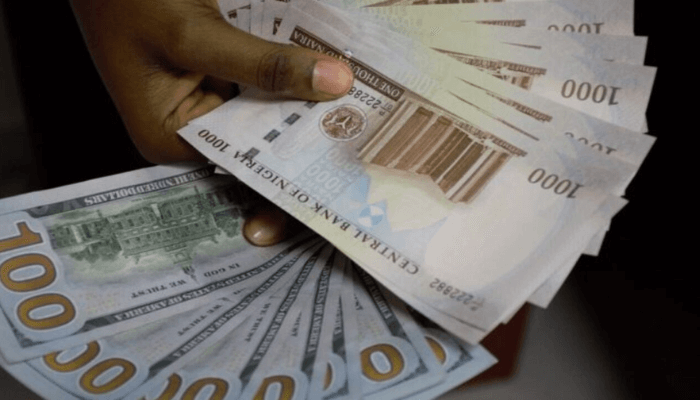
As the third quarter of 2023 came to a close, the Nigerian economy bore witness to a worrisome development – the sharp depreciation of the national currency, the naira.  According to data compiled by Nairametrics, the official exchange rate at the end of Q3 stood at N755.27/$1, a notable decline from the N769.25/$1 rate recorded at the close of Q2. This decline in the official exchange rate, however, pales in comparison to the more alarming figures reported on the parallel or “black” market, where the naira plummeted from N770/$1 to N1000/$1 over the same period, resulting in a staggering 23% loss.

AlsoRead

Naira Weakness Pushes Foreign Currency Taxes to N6.33 Trillion in 2025

CBN Maintains Restrictions on BDC Access to Official Forex Market Over Compliance Concerns

Naira Drops to Three-Week Low at ₦1,361.5 per Dollar Amid Persistent FX Pressure

Simultaneously, Nigeria’s external reserves have experienced a decrease from $34.1 billion at the end of the second quarter to $33.2 billion by the end of the third quarter, prompting further concerns about the nation’s economic stability.

The widening gap between the official and unofficial exchange rates underscores the persistent scarcity of foreign exchange in Nigeria, exacerbated by the divergent policies of the Central Bank of Nigeria (CBN) and market forces. The CBN has attributed the currency depreciation primarily to a forex backlog estimated to be between $6 billion and $10 billion.

During a recent Senate confirmation hearing for the central bank governor, Yemi Cardoso emphasized the need to address these unsettled obligations, stating, “Number one – it is that of which I’ll term an operational issue. Right now, we have a situation where we are aware there are unsettled obligations of the central bank, whether it is $4 billion, $5 billion, $7 billion, I don’t know. But definitely, the immediate priority will be to verify the authenticity and extent of the unsettled obligation, and once we do that, we need to look for a way to take care of it. It would be naive for us to think we will be able to make progress if we don’t handle that side of the foreign exchange.”

The depreciation of the naira has had detrimental effects on the Nigerian economy, including increased import costs, elevated inflation rates, a decline in purchasing power, and a discouraging environment for investment. In September, the National Bureau of Statistics (NBS) reported that the inflation rate had risen to 25.8%, further highlighting the challenges faced by the nation.

Looking ahead, analysts anticipate continued pressure on the naira in the fourth quarter of 2023. This follows a sharp depreciation observed in November 2022 after the CBN announced its currency redesign policy. To potentially mitigate further depreciation, the CBN may need to devalue the official exchange rate to align it with market realities and preserve the dwindling external reserves, which have dropped from $34.1 billion in June to $33.2 billion in September.

Analysts at Ratecaptain suggest that a more significant devaluation might be averted if the CBN can fulfill its obligations to clear the forex backlogs. However, achieving this may necessitate the government seeking new loans from friendly countries.

Without swift action on these fronts, experts with a cautious outlook believe that the parallel market rate may breach the N1100/$1 mark by December, driven by increasing demand for dollars ahead of the festive season and amid a new wave of Nigerians seeking to relocate abroad in the coming year, popularly referred to as “Japa.” The challenge ahead for Nigeria’s economic stability remains substantial, with the naira’s performance in the last quarter serving as a stark reminder of the hurdles that lie ahead.

Tags: #inflationCentral Bank of Nigeriacurrency depreciationCurrency Devaluationeconomic outlookeconomic stabilityexchange ratesExternal ReservesFinancial NewsForex BacklogsNairametricsNigeria Financial Trends.Nigerian economyNigerian NairaParallel Market
Previous Post

Stocks to Watch: Sphere Entertainment, Bitcoin and More

Next Post

UK and US Pledge Support to Boost Nigeria’s Marine and Blue Economy Ministry

Related News

Naira appreciated to N738/$ in the Parallel Market

Naira Weakness Pushes Foreign Currency Taxes to N6.33 Trillion in 2025

by Stephen Akudike
April 29, 2026
0

Nigeria’s tax receipts denominated in foreign currency rose sharply to N6.33 trillion in 2025, representing a 27.3% increase from N4.97...

CBN to Release Full List of Licensed Bureau De Change Operators

CBN Maintains Restrictions on BDC Access to Official Forex Market Over Compliance Concerns

by Jide Omodele
April 29, 2026
0

The Central Bank of Nigeria (CBN) has sustained its tight restrictions on Bureau De Change (BDC) operators’ access to the...

Naira depreciates to N755/$ in the parallel market.

Naira Drops to Three-Week Low at ₦1,361.5 per Dollar Amid Persistent FX Pressure

by Stephen Akudike
April 29, 2026
0

The Nigerian naira weakened to its lowest level in three weeks on Friday, as foreign exchange market pressures continued to...

CBN Supplies $29.5 Million at FX Auction as Naira Depreciates at I&E Window.

Nigeria’s External Reserves Drop by $731 Million in Early April

by Jide Omodele
April 28, 2026
0

Nigeria’s foreign exchange reserves came under renewed pressure in April 2026, declining by approximately $731 million within the first three...

Next Post
UK and US Pledge Support to Boost Nigeria’s Marine and Blue Economy Ministry

UK and US Pledge Support to Boost Nigeria's Marine and Blue Economy Ministry

Leave a Reply Cancel reply

Your email address will not be published. Required fields are marked *

Recommended

IMF Cautions Central African Republic against Adopting Bitcoin

Bitcoin Tests $80,000 Resistance as It Remains Range-Bound Ahead of FOMC Decision

April 29, 2026
Naira appreciated to N738/$ in the Parallel Market

Naira Weakness Pushes Foreign Currency Taxes to N6.33 Trillion in 2025

April 29, 2026

Popular Story

  • IMF advised CBN to extend the banknote swap deadline.

    IMF Identifies High Inflation as a Major Hardship for Nigerians

    0 shares
    Share 0 Tweet 0
  • Chinese smartphone firms jazz up products, seize turf in home market from Apple

    0 shares
    Share 0 Tweet 0
  • Naira crashes to record low at NAFEX as low dollar supply persists

    0 shares
    Share 0 Tweet 0
  • Lai Mohammed Slams Media Houses for Celebrating End-SARS Panel Report

    0 shares
    Share 0 Tweet 0
  • Oil resource managers in Nigeria must account for crude oil theft—FG.

    0 shares
    Share 0 Tweet 0

RateCaptain

We bring you the most accurate in new and market data. Check our landing page for details.

  • Home
  • About Us
  • Privacy Policy
  • Terms & Conditions
  • Disclaimer
  • Cookie Policy
  • Contact Us

Copyright © 2022 RateCaptain - All rights reserved by RateCaptain.

No Result
View All Result
  • Home
    • About Us
    • Contact Us
  • FX Rates
  • Money Market
  • Cryptocurrency
  • Commodities
  • Corporates

Copyright © 2022 RateCaptain - All rights reserved by RateCaptain.

RateCaptain
Manage Cookie Consent
To provide the best experiences, we use technologies like cookies to store and/or access device information. Consenting to these technologies will allow us to process data such as browsing behavior or unique IDs on this site. Not consenting or withdrawing consent, may adversely affect certain features and functions.
Functional Always active
The technical storage or access is strictly necessary for the legitimate purpose of enabling the use of a specific service explicitly requested by the subscriber or user, or for the sole purpose of carrying out the transmission of a communication over an electronic communications network.
Preferences
The technical storage or access is necessary for the legitimate purpose of storing preferences that are not requested by the subscriber or user.
Statistics
The technical storage or access that is used exclusively for statistical purposes. The technical storage or access that is used exclusively for anonymous statistical purposes. Without a subpoena, voluntary compliance on the part of your Internet Service Provider, or additional records from a third party, information stored or retrieved for this purpose alone cannot usually be used to identify you.
Marketing
The technical storage or access is required to create user profiles to send advertising, or to track the user on a website or across several websites for similar marketing purposes.
  • Manage options
  • Manage services
  • Manage {vendor_count} vendors
  • Read more about these purposes
View preferences
  • {title}
  • {title}
  • {title}
?>