RateCaptain
  • Home
    • About Us
    • Contact Us
  • FX Rates
  • Money Market
  • Cryptocurrency
  • Commodities
  • Corporates
No Result
View All Result
Subscribe
  • Home
    • About Us
    • Contact Us
  • FX Rates
  • Money Market
  • Cryptocurrency
  • Commodities
  • Corporates
No Result
View All Result
RateCaptain
No Result
View All Result
Home Economy

NLC Demands Reversal of Fuel Price Hike as Petrol Hits N1,030 Per Litre

Victoria Attah by Victoria Attah
October 10, 2024
in Economy, Energy
Reading Time: 3 mins read
A A
0
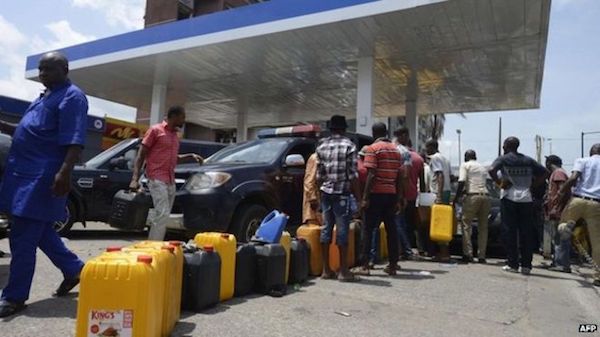
Fuel Subsidy Removal Sparks Market Turmoil: Uncertainty and Fuel Queues Grip Nigeria.
Share on FacebookShare on TwitterShare on WhatsappShare on Telegram

The Nigeria Labour Congress (NLC) and the Organised Private Sector have strongly condemned the recent increase in petrol prices by the Nigerian National Petroleum Company Limited (NNPCL), calling for an immediate reversal. The price of Premium Motor Spirit (PMS), commonly known as petrol, has risen significantly to N1,030 per litre in Abuja, with similar hikes recorded across the country. In Lagos, petrol now sells for N998 per litre.

This marks the second price hike in a month, with the increase representing a 14.8% jump. The latest development comes just months after the NNPC raised the price to N897 per litre in September, prompting widespread public dissatisfaction. Since the current administration took office in May 2023, the price of petrol has surged by over 430%, placing additional financial strain on Nigerians.

AlsoRead

Naira Breaks Below N1,400 as Oil Rally and CBN Reforms Fuel Fresh Stability

Larger Disparities Boom Between Black Market and Official Rates

Emefiele’s Naira Redesign Memo Takes Centre Stage in EFCC Trial

At NNPC’s mega station in the Central Area of Abuja, customers expressed frustration over the lack of transparency, as the station failed to display prices. Instead, attendants verbally informed buyers of the new rate. One customer, speaking to *The PUNCH*, shared their frustration after waiting in line only to learn of the price hike after fueling.

Fuel prices have also risen sharply in other parts of the country. In Abuja, petrol is selling for as high as N1,200 per litre at some stations, while prices in states like Kwara, Edo, Delta, and Benue range between N1,100 and N1,300 per litre. In Borno State, the price has hit N1,250 per litre, with many stations remaining closed, causing artificial scarcity.

Impact on Transportation and Economy

The latest fuel price hike has already led to an increase in transportation costs. In Abuja, fares for routes such as Lugbe to Wuse have jumped from N700 to N1,000, while similar increases have been observed nationwide. With the price of petrol surpassing N1,000 per litre, many Nigerians fear the long-term economic consequences.

 NLC’s Response

The NLC has been vocal in its opposition to the fuel price increase, demanding an immediate reversal. In a statement, NLC President Joe Ajaero criticized the NNPCL for acting as a monopolistic entity, setting fuel prices unilaterally. Ajaero called on the government to outline a comprehensive plan for economic growth instead of relying on sporadic price hikes.

Ajaero warned that the price increase would exacerbate poverty, reduce production capacity, and lead to further job losses. He urged the government to reconsider its approach, stating that previous increases had not benefited Nigerians and only deepened their economic challenges.

Concerns from the Organised Private Sector

The Organised Private Sector, including the Manufacturers Association of Nigeria (MAN), echoed similar concerns. Segun Ajayi-Kadir, the Director-General of MAN, said the price hike would increase production costs for manufacturers, leading to higher prices for locally produced goods. He also noted that the higher cost of transportation would further reduce consumers’ purchasing power, affecting sales and economic activity.

Ajayi-Kadir expressed hope that the government would find ways to reduce fuel costs, possibly by incentivizing local production at the Dangote Refinery, which recently began operations. He suggested that if the government could provide crude oil to local refineries at lower prices, it could serve as a form of subsidy for Nigerians, helping to mitigate the rising costs of petrol.

Bottom Line

As fuel prices soar, the NLC and the Organised Private Sector continue to push for a reversal of the recent hikes, warning of the severe economic implications for Nigerians. With transportation costs rising and disposable incomes shrinking, the latest development has sparked widespread concern about the affordability of essential goods and services. The government’s next steps will be critical in addressing the growing discontent and mitigating the economic fallout of the fuel price hikes.

Tags: #NigeriaFuel Price HikeNLCNNPCLpetrol price
Previous Post

DSS Accuses CBN Staff of Aiding in Theft of Anchor Borrowers’ Funds

Next Post

Kenyan Shilling Gains 17% Amid Two Interest Rate Cuts in 2024 as Inflation Eases

Related News

Angola Surpasses Nigeria, Becomes Africa’s Largest Oil Producer in August

Naira Breaks Below N1,400 as Oil Rally and CBN Reforms Fuel Fresh Stability

by Akpan Edidong
February 5, 2026
0

Nigeria’s naira has strengthened markedly in the official foreign exchange market, closing January at N1,386.55 per US dollar  its firmest...

Naira Surges Against US Dollar, Falls Below N1,000 Mark

Larger Disparities Boom Between Black Market and Official Rates

by Stephen Akudike
February 5, 2026
0

The gap between Nigeria’s official and parallel (black market) exchange rates has widened to over 6%, reviving fears of renewed...

U.S. Steps In on Emefiele Trial, Alleges Human Rights Violations

Emefiele’s Naira Redesign Memo Takes Centre Stage in EFCC Trial

by Victoria Attah
February 5, 2026
0

A 2022 memo from former Central Bank of Nigeria (CBN) Governor Godwin Emefiele seeking presidential approval for the controversial naira...

FG Allocates N5.1 Billion for Presidential Yacht and N5.5 Billion For Student Loans

Government Securities Now 11% of Nigerian Banks’ Assets as Credit Growth Lags

by Stephen Akudike
February 4, 2026
0

Nigerian banks’ exposure to government securities has risen sharply in recent years, now accounting for approximately 11% of their total...

Next Post
Kenyan Shilling Gains 17% Amid Two Interest Rate Cuts in 2024 as Inflation Eases

Kenyan Shilling Gains 17% Amid Two Interest Rate Cuts in 2024 as Inflation Eases

Leave a Reply Cancel reply

Your email address will not be published. Required fields are marked *

Recommended

Angola Surpasses Nigeria, Becomes Africa’s Largest Oil Producer in August

Naira Breaks Below N1,400 as Oil Rally and CBN Reforms Fuel Fresh Stability

February 5, 2026
Naira Surges Against US Dollar, Falls Below N1,000 Mark

Larger Disparities Boom Between Black Market and Official Rates

February 5, 2026

Popular Story

  • Zenith Bank Appoints Ebenezer Onyeagwu GMD/CEO

    0 shares
    Share 0 Tweet 0
  • Telecoms sector Q1 revenue hits N2tr

    0 shares
    Share 0 Tweet 0
  • India Raises Interest Rates For First Time In Four Years

    0 shares
    Share 0 Tweet 0
  • Volkswagen Profits Soar Despite Diesel Scandal

    0 shares
    Share 0 Tweet 0
  • Nigeria’s debt hits N24.39tn, rises by N2.66tn in one year

    0 shares
    Share 0 Tweet 0
RateCaptain

RateCaptain

We bring you the most accurate in new and market data. Check our landing page for details.

  • Home
  • About Us
  • Privacy Policy
  • Terms & Conditions
  • Disclaimer
  • Cookie Policy
  • Contact Us

Copyright © 2022 RateCaptain - All rights reserved by RateCaptain.

No Result
View All Result
  • Home
    • About Us
    • Contact Us
  • FX Rates
  • Money Market
  • Cryptocurrency
  • Commodities
  • Corporates

Copyright © 2022 RateCaptain - All rights reserved by RateCaptain.

RateCaptain
Manage Cookie Consent
To provide the best experiences, we use technologies like cookies to store and/or access device information. Consenting to these technologies will allow us to process data such as browsing behavior or unique IDs on this site. Not consenting or withdrawing consent, may adversely affect certain features and functions.
Functional Always active
The technical storage or access is strictly necessary for the legitimate purpose of enabling the use of a specific service explicitly requested by the subscriber or user, or for the sole purpose of carrying out the transmission of a communication over an electronic communications network.
Preferences
The technical storage or access is necessary for the legitimate purpose of storing preferences that are not requested by the subscriber or user.
Statistics
The technical storage or access that is used exclusively for statistical purposes. The technical storage or access that is used exclusively for anonymous statistical purposes. Without a subpoena, voluntary compliance on the part of your Internet Service Provider, or additional records from a third party, information stored or retrieved for this purpose alone cannot usually be used to identify you.
Marketing
The technical storage or access is required to create user profiles to send advertising, or to track the user on a website or across several websites for similar marketing purposes.
  • Manage options
  • Manage services
  • Manage {vendor_count} vendors
  • Read more about these purposes
View preferences
  • {title}
  • {title}
  • {title}
?>