RateCaptain
  • Home
    • About Us
    • Contact Us
  • FX Rates
  • Money Market
  • Cryptocurrency
  • Commodities
  • Corporates
No Result
View All Result
Subscribe
  • Home
    • About Us
    • Contact Us
  • FX Rates
  • Money Market
  • Cryptocurrency
  • Commodities
  • Corporates
No Result
View All Result
RateCaptain
No Result
View All Result
Home Economics

Saudi Arabia cuts ties with the United States for economic Independence.

Rate Captain by Rate Captain
April 4, 2023
in Economics
Reading Time: 4 mins read
A A
0
Saudi Arabia cuts ties with the United States for economic Independence.
Share on FacebookShare on TwitterShare on WhatsappShare on Telegram

Saudi Arabia and other major oil producers on Sunday announced surprise cuts totaling up to 1.15 million barrels per day from May until the end of the year, a move that could raise prices worldwide.

Higher oil prices would help fill Russian President Vladimir Putin’s coffers as his country wages war on Ukraine and force Americans and others to pay even more at the pump amid worldwide inflation.

AlsoRead

Nigeria’s Inflation Eases to 20.12% in August, Prompting Calls for CBN Rate Cuts

African Nations Grapple with Soaring Borrowing Costs in 2025 Amid Inflation Surge

CBN Holds Policy Rates Steady Amid Global Economic Challenges

It was also likely to further strain ties with the United States, which has called on Saudi Arabia and other allies to increase production as it tries to bring prices down and squeeze Russia’s finances.

The production cuts alone could push U.S. gasoline prices up by roughly 26 cents per gallon, in addition to the usual increase that comes when refineries change the gasoline blend during the summer driving season, said Kevin Book, managing director of Clearview Energy Partners LLC. The Energy Department calculates the seasonal increase at an average of 32 cents per gallon, Book said.

Therefore, with an average U.S. price now at roughly $3.50 per gallon of regular, according to AAA, that could mean gasoline is over $4 per gallon during the summer. However, Book said there are a number of complex variables in oil and gas prices. The size of each country’s production cut depends on the baseline production number it is using, so the cut might not be 1.15 million. It also could take much of the year for the cuts to take effect. Demand could fall if the U.S. enters a recession caused by the banking crisis. But it also could increase during the summer as more people travel.

Even though the production cut is only about 1% of the roughly 100 million barrels of oil the world uses per day, the impact on prices could be big, Book said.

“It’s a big deal because of the way oil prices work,” he said. “You are in a market that is relatively balanced. You take a small amount away, depending on what demand does, you could have a very significant price response.”

Saudi Arabia announced the biggest cut among OPEC members at 500,000 barrels per day. The cuts are in addition to a reduction announced last October that infuriated the Biden administration.

The Saudi Energy Ministry described the move as a “precautionary measure” aimed at stabilizing the oil market. The cuts represent less than 5% of Saudi Arabia’s average production of 11.5 million barrels per day in 2022.

Iraq said it would reduce production by 211,000 barrels per day, the United Arab Emirates by 144,000, Kuwait by 128,000, Kazakhstan by 78,000, Algeria by 48,000 and Oman by 40,000.

The announcements were carried by each country’s state media. Russia’s Deputy Prime Minister Alexander Novak meanwhile said Moscow would extend a voluntary cut of 500,000 until the end of the year, according to remarks carried by the state news agency Tass. Russia had announced the unilateral reduction in February after Western countries imposed price caps.

All are members of the so-called OPEC+ group of oil exporting countries, which includes the original Organization of the Petroleum Exporting Countries as well as Russia and other major producers. There was no immediate statement from OPEC itself.

The cuts announced in October of some 2 million barrels a day had come on the eve of U.S. midterm elections in which soaring prices were a major issue. President Joe Biden vowed at the time that there would be “consequences” and Democratic lawmakers called for freezing cooperation with the Saudis.

Both the U.S. and Saudi Arabia denied any political motives in the dispute. Since those cuts, oil prices have trended down. Brent crude, a global benchmark, was trading around $80 a barrel at the end of last week, down from around $95 in early October, when the earlier cuts were agreed.

Analysts Giacomo Romeo and Lloyd Byrne at Jefferies said in a research note that the new cuts should allow for “material” reductions to OPEC inventory earlier than expected and could validate recent warnings from some traders and analysts that demand for oil is weakening.

Kristian Coates Ulrichsen, a Gulf expert at Rice University’s Baker Institute for Public Policy, said the Saudis are determined to keep oil prices high enough to fund ambitious mega-projects linked to Crown Prince Mohammed bin Salman’s Vision 2030 plan to overhaul the economy.

“This domestic interest takes precedence in Saudi decision-making over relationships with international partners and is likely to remain a point of friction in U.S.-Saudi relations for the foreseeable future,” he said.

Saudi Arabia’s state-run oil giant Aramco recently announced record profits of $161 billion from last year. Profits rose 46.5% when compared to the company’s 2021 results of $110 billion. Aramco said it hoped to boost production to 13 million barrels a day by 2027.

The decades-long U.S.-Saudi alliance has come under growing strain in recent years following the 2018 killing of Saudi dissident Jamal Khashoggi, a U.S.-based journalist, and Saudi Arabia’s war with the Iran-backed Houthi rebels in Yemen.

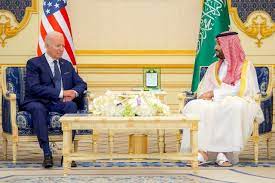
As a candidate for president, Biden had vowed to make Saudi Arabia a “pariah” over the Khashoggi killing, but as oil prices rose after his inauguration he backed off. He visited the kingdom last July in a bid to patch up relations, drawing criticism for sharing a fist bump with Crown Prince Mohammed.

Saudi Arabia has denied siding with Russia in the Ukraine war, even as it has cultivated closer ties with both Moscow and Beijing in recent years. Last week, Aramco announced billions of dollars of investment in China’s downstream petrochemicals industry.


Previous Post

German foundation commits €5m to agriculture intervention in Nigeria.

Next Post

FG approves amendment of 2022/2023 deep offshore oil block bid round.

Related News

Nigeria’s Inflation Eases to 20.12% in August, Prompting Calls for CBN Rate Cuts

by Stephen Akudike
September 16, 2025
0

Nigeria’s headline inflation rate dropped to 20.12% in August 2025, marking its fifth consecutive month of decline from 21.88% in...

IMF Lists Top 10 African Nations with Highest Debt Burdens

African Nations Grapple with Soaring Borrowing Costs in 2025 Amid Inflation Surge

by Akpan Edidong
August 6, 2025
0

Across Africa, central banks are wielding high Monetary Policy Rates (MPRs) as a weapon against persistent inflation, currency volatility, and...

NEC Affirms CBN $3 Billion Loan for Naira Stability

CBN Holds Policy Rates Steady Amid Global Economic Challenges

by Stephen Akudike
July 31, 2025
0

The Central Bank of Nigeria (CBN) maintained its key monetary policy instruments at the July 2025 Monetary Policy Committee (MPC)...

Nigeria and UK Set to Sign Enhanced Trade Investment Partnership Agreement

UK-Nigeria Standards Partnership Boosts Nigerian Exports with Zero Tariffs for 3,500 Products

by Akpan Edidong
July 25, 2025
0

Nigeria’s export sector received a significant lift with the launch of the third phase of the UK-Nigeria Standards Partnership Programme,...

Next Post
FG approves amendment of 2022/2023 deep offshore oil block bid round.

FG approves amendment of 2022/2023 deep offshore oil block bid round.

Leave a Reply Cancel reply

Your email address will not be published. Required fields are marked *

Recommended

2024 Budget Outline: Oil Price Set at $77.96, Naira Stands at 750 Against the Dollar

Nigeria and UAE Sign Landmark Trade Deal to Eliminate Tariffs on Thousands of Products

January 27, 2026
 Top Story: Central Bank Raises MPR by 200 Basis Points to 24.75%

National Grid Collapses Again, Plunging Nigeria into Nationwide Blackout

January 27, 2026

Popular Story

  • LIRS Shuts 34 Companies Over Tax Non-Compliance

    LIRS Warns Banks, Employers and Others: We’ll Deduct Unpaid Taxes Directly from Your Funds

    0 shares
    Share 0 Tweet 0
  • Nigeria and UAE Sign Landmark Trade Deal to Eliminate Tariffs on Thousands of Products

    0 shares
    Share 0 Tweet 0
  • Dangote Refinery Suspends Petrol Sales and Cancels Contracts as Crude Supply Issues Bite

    0 shares
    Share 0 Tweet 0
  • US Records $1.45 Billion Trade Surplus with Nigeria in First 10 Months of 2025 as Exports Surge 60%

    0 shares
    Share 0 Tweet 0
  • Nigeria Customs Service Surpasses N7.2 Trillion Revenue Target in 2025

    0 shares
    Share 0 Tweet 0
RateCaptain

RateCaptain

We bring you the most accurate in new and market data. Check our landing page for details.

  • Home
  • About Us
  • Privacy Policy
  • Terms & Conditions
  • Disclaimer
  • Cookie Policy
  • Contact Us

Copyright © 2022 RateCaptain - All rights reserved by RateCaptain.

No Result
View All Result
  • Home
    • About Us
    • Contact Us
  • FX Rates
  • Money Market
  • Cryptocurrency
  • Commodities
  • Corporates

Copyright © 2022 RateCaptain - All rights reserved by RateCaptain.

RateCaptain
Manage Cookie Consent
To provide the best experiences, we use technologies like cookies to store and/or access device information. Consenting to these technologies will allow us to process data such as browsing behavior or unique IDs on this site. Not consenting or withdrawing consent, may adversely affect certain features and functions.
Functional Always active
The technical storage or access is strictly necessary for the legitimate purpose of enabling the use of a specific service explicitly requested by the subscriber or user, or for the sole purpose of carrying out the transmission of a communication over an electronic communications network.
Preferences
The technical storage or access is necessary for the legitimate purpose of storing preferences that are not requested by the subscriber or user.
Statistics
The technical storage or access that is used exclusively for statistical purposes. The technical storage or access that is used exclusively for anonymous statistical purposes. Without a subpoena, voluntary compliance on the part of your Internet Service Provider, or additional records from a third party, information stored or retrieved for this purpose alone cannot usually be used to identify you.
Marketing
The technical storage or access is required to create user profiles to send advertising, or to track the user on a website or across several websites for similar marketing purposes.
  • Manage options
  • Manage services
  • Manage {vendor_count} vendors
  • Read more about these purposes
View preferences
  • {title}
  • {title}
  • {title}
?>