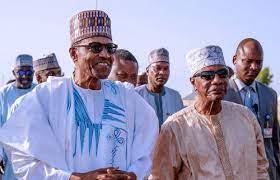
President of Guinea, Alpha Conde, on 10 august 2019, met President Muhammadu Buhari in Katsina State for Eid El-Kabir celebrations. Mr Conde’s visit was intended to provide an opportunity to reinforce the strong relationship between the two leaders and both nations, and for them to engage in discussions on bilateral and global matters.
Fast forward to the 6th September 2021 , The Federal Government has condemned the coup d’etat that happened today in the Republic of Guinea, saying it violates ECOWAS Protocol on Democracy and Good Governance.
This was strongly condemned by the Federal Government in a statement titled, ‘Nigerian Government Condemns Could D’Etat In Guinea,’ signed by the Spokesperson, Ministry of Foreign Affairs, Esther Sunsuwa.
“The Government of Nigeria strongly condemns and rejects any unconstitutional change of government and therefore calls on those behind the coup to restore constitutional order without delay and protect lives and property.”
Impacts Of This Coup d’état
Guinea has no functioning free trade or export processing zones or warehouses, but a special economic zone is being set up in Boke, and a temporary license to conduct free trade transactions can be obtained with special permission from the Ministry of Economy and Finance.
Countries with bilateral investment protection agreements include Belgium, Benin, China, France, The Gambia, Germany, Iran, Italy, Japan, the Republic of Korea, Morocco, Nigeria, Saudi Arabia, Senegal, South Africa, Switzerland, Tunisia, Turkey, and the United Kingdom.
Nigeria’s trade with the other countries that belong to the Economic Community of West African States (ECOWAS) remains poor as do aggregate trade flows among all the ECOWAS member states. Specifically, Nigeria’s export to the ECOWAS region, which averaged about 7 percent of its total exports between 2001 and 2006, plummeted to 2.3 percent in 2010.
The vast majority of Nigeria’s exports to the ECOWAS are mineral fuel and oils, which reached 97 percent and 94 percent, respectively, in 2009 and 2010. Comparatively, the share of manufacturing in Nigeria’s total exports to the ECOWAS region climbed from 1 percent in 2001 to 5.4 percent in 2010, while the share of Nigeria’s agricultural exports—which was 3 percent in 2001—plunged to nearly nothing in 2009 and 2010. Likewise, the share of other ECOWAS countries in Nigeria’s imports dropped from 4.4 percent in 2001 to less than 0.5 percent in 2010.The prospect for significant trade between Nigeria and other countries in the ECOWAS zone is constrained by parallel or noncomplementary production structures across member countries.
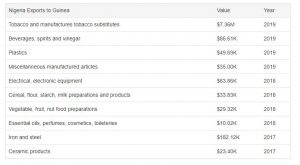
Nigeria Exports to Guinea was US$7.53 Million during 2019, according to the United Nations COMTRADE database on international trade.

Data Source: Trading Economics
Conclusion
From data provided above it will be very unusual for the Nigerian economy to be significantly affected by the political turmoil ongoing in guinea. however, As Nigeria being regarded as an African power shell with respect to goodwill the intervention of the Nigerian government has the potency to be necessary.