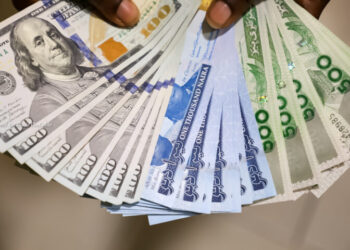
The Nigerian naira has surged to its highest value against the U.S. dollar since March 2025, settling at N1,500.91 in mid-week trading on the official foreign exchange market. This represents a significant milestone for the local currency, which has fluctuated between N1,498/$ and N1,507/$ in recent sessions, demonstrating a robust recovery after months of volatility.
The naira’s rise marks the second time this week that it broke through the N1,500/$ threshold, a key psychological barrier for the Nigerian economy. This latest positive trend has been attributed to the Central Bank of Nigeria’s (CBN) ongoing efforts to stabilize the nation’s currency through a series of monetary policy reforms aimed at curbing speculative trading and attracting foreign investment.
Earlier this week, the naira had improved to N1,506/$ on Monday and maintained that level through Tuesday before gaining further ground by Wednesday. While the official market has seen a steady rise, the naira traded slightly lower on the black market, where it settled in the N1,510/$ to N1,512/$ range.
This uptick in the naira’s value comes at a time of renewed confidence in Nigeria’s economic reforms, with the CBN continuing to implement measures that help stabilize exchange rates and reduce volatility in the foreign exchange market. Additionally, the naira’s strength has positively impacted the Nigerian stock market, where companies are benefiting from more favorable exchange rates to manage import costs and report improved earnings.
Market analysts view the naira’s recovery as a cautious sign that the currency’s recent gains may help alleviate some inflationary pressures, particularly those tied to Nigeria’s import-heavy consumption.
In the global market, the U.S. dollar remained stable, with the U.S. Dollar Index (DXY) holding steady at 97.85 during the London trading session. Investors are closely monitoring the U.S. Consumer Price Index (CPI) data for August, which is expected to influence the Federal Reserve’s next monetary policy decisions. Speculation about an upcoming rate cut by the Federal Reserve has added uncertainty to global financial markets.
Meanwhile, the euro strengthened ahead of the European Central Bank’s (ECB) policy meeting, with analysts predicting that interest rates will likely remain unchanged, despite growing geopolitical tensions in Europe. This includes the recent escalation of tensions on the continent’s eastern borders, as Poland shot down Russian drones with NATO support earlier this week.
As Nigeria’s currency stabilizes, there are cautious hopes that the naira’s strength will continue, fostering a more favorable environment for businesses and consumers alike in the months ahead.