RateCaptain
  • Home
    • About Us
    • Contact Us
  • FX Rates
  • Money Market
  • Cryptocurrency
  • Commodities
  • Corporates
No Result
View All Result
Subscribe
  • Home
    • About Us
    • Contact Us
  • FX Rates
  • Money Market
  • Cryptocurrency
  • Commodities
  • Corporates
No Result
View All Result
RateCaptain
No Result
View All Result
Home Business

Nigeria Was Once Projected to Have The Highest Foreign Direct Investment by 2020, What Happened ?

Rate Captain by Rate Captain
July 29, 2021
in Business, Economics, News, Opinion, Research
Reading Time: 2 mins read
A A
0
Share on FacebookShare on TwitterShare on WhatsappShare on Telegram

Foreign direct investment (FDI) is an investment from a party in one country into a business or corporation in another country with the intention of establishing a lasting interest. Lasting interest differentiates FDI from foreign portfolio investments, where investors passively hold securities from a foreign country. A foreign direct investment can be made by obtaining a lasting interest or by expanding one’s business into a foreign country.

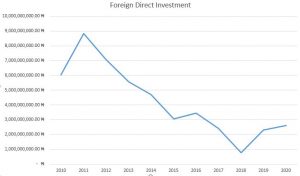
Foreign investment in Nigeria has been on a persistent fall since 2011 , From 2011 to 2013 nigeria was the top destination for FDI.
AlsoRead

Cement Price Surges to N12,000 per Bag, Raising Fears of Deeper Housing Crisis

Nigeria’s FX Market Turnover Hits $10 Billion in April as Naira Strengthens

Dangote Cement Eyes London Stock Exchange Listing Before End of 2026

Experts have said this steady inflow of FDI into Nigeria will accelerate the country’s quest to rank among the top 20 economies in the world by the year 2020.For instance, they point out substantial improvement in power supply, as is currently being recorded, will help Nigeria move rapidly to the next level of development. It is expected that the various power projects which GE intends to execute in partnership with local firms, will further boost output. This will have multiplier effect on virtually all sectors of the economy, as it will lead to lower production costs and more profitability for companies.


Fast-forward to 2021 and the FDI value is 2.6 billion Naira a minimal increment from 2020 value of 2.3 billion naira

WHY HAS NIGERA’S FOREIGN DIRECT INVESTMENT BEEN ON AN AVERAGE DECLINE ?

  • GDP: The Gross Domestic Product (GDP) in Nigeria was worth 432.30 billion US dollars in 2020 compared to 2019 which was $448 billion dollars.A country withfluctuating GDP discourages FDI and creates uncertenties in the investment market.
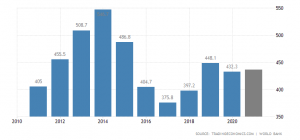
A country with fluctuating GDP discourages FDI and creates uncertainties in the investment market.


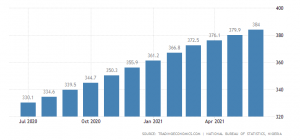
  • Inflation: The inflation rate (consumer price index) of a country—used as a proxy for macro-economic stability. Inflation rate in Nigeria has been on a consistently high rate since 2019 to 2021 the current rate stands at approximately 17%. From the chart below inflation has been an a draconian rise since july 2020
  • Trade: Representing openness to trade i.e., the ratio of total trade (exports + imports) to GDP—used as a policy variable. The recent investment on infrastructure can be seen as a bright light, because this can facilitate trade. The recently completed border project between Nigeria and Cameroon serves a conduit for boosting trade and increase FDI.
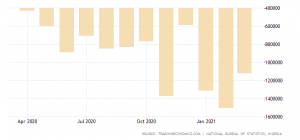
  • Nigeria’s trade deficit widened to NGN 1123.3 billion in March of 2021 from NGN 554.5 billion in the same month a year ago. Imports surged 44.4% to NGN 2194 billion while exports rose at a softer 11% to NGN 1070 billion. Considering the first quarter of 2021, the country’s trade gap widened to a record high of NGN 3944 billion from NGN 330 billion in the same period a year ago, as imports surged 54% to NGN 6851 billion, its highest level in over 12 years, due to higher purchases of energy goods (1347%), agricultural goods (141%) and raw materials (109%). Conversely, exports fell 29.3% to NGN 2907 billion, as shipments fell primarily for manufactured products (-43.7%) and crude oil (-34.5%). China, India, the Netherlands, Spain and the US were the main trading partners in Q1
Previous Post

A New Bitcoin Mutual Fund Is Making It Easier to Invest in Crypto

Next Post

CBN orders banks to set up teller points at branches for foreign exchange sales to customers

Related News

Dangote Cement to pay N340 dividend to shareholders.

Cement Price Surges to N12,000 per Bag, Raising Fears of Deeper Housing Crisis

by Victoria Attah
May 11, 2026
0

Stakeholders in Nigeria’s construction and real estate sector have expressed serious concern over the sharp rise in cement prices, which...

Naira appreciated to N738/$ in the Parallel Market

Nigeria’s FX Market Turnover Hits $10 Billion in April as Naira Strengthens

by Jide Omodele
May 11, 2026
0

Nigeria’s foreign exchange market recorded improved liquidity in April 2026, with total turnover reaching $10 billion, according to data from...

Dangote: Cement Industry Contributes 7% to Global Emissions

Dangote Cement Eyes London Stock Exchange Listing Before End of 2026

by Jide Omodele
May 8, 2026
0

Africa’s largest cement producer, Dangote Cement Plc, is preparing for a secondary listing on the London Stock Exchange (LSE) later...

South Africa Poised to Surpass Nigeria as Africa’s Largest Economy

Nigeria’s Fixed Income Market Set for Massive N10.53 Trillion Liquidity Inflow in May

by Jide Omodele
May 8, 2026
0

Nigeria’s money market is expected to experience a significant surge in liquidity this month, with the Financial Markets Dealers Association...

Next Post

CBN orders banks to set up teller points at branches for foreign exchange sales to customers

Leave a Reply Cancel reply

Your email address will not be published. Required fields are marked *

Recommended

Leading Banks Struggle with Capital Deficits: Zenith Bank and Others Strive to Meet CBN Standards

Bad Loans Hits N2.36 Trillion in Nigeria’s Banking Sector

May 11, 2026
CBN – FG incurred N930.8bn Fiscal Deficit in January and February 2023.

Nigeria’s External Reserves Drop by $855 Million in Five Weeks

May 11, 2026

Popular Story

  • Nigeria’s Debt to China Surges by $800 Million in One Year

    31 Nigerian States Grapple with N2.57 Trillion Domestic Debt Amid No Foreign Inflows

    0 shares
    Share 0 Tweet 0
  • Shocking: “Undress” An AI Tool That Unveils Digital Representations of Individuals Without Clothing

    0 shares
    Share 0 Tweet 0
  • Dangote Cement Eyes London Stock Exchange Listing Before End of 2026

    0 shares
    Share 0 Tweet 0
  • How an Average Nigerian can invest in Government Bonds or Treasury Bills

    0 shares
    Share 0 Tweet 0
  • Declining reserves, rising inflation to dominate MPC considerations

    0 shares
    Share 0 Tweet 0

RateCaptain

We bring you the most accurate in new and market data. Check our landing page for details.

  • Home
  • About Us
  • Privacy Policy
  • Terms & Conditions
  • Disclaimer
  • Cookie Policy
  • Contact Us

Copyright © 2022 RateCaptain - All rights reserved by RateCaptain.

No Result
View All Result
  • Home
    • About Us
    • Contact Us
  • FX Rates
  • Money Market
  • Cryptocurrency
  • Commodities
  • Corporates

Copyright © 2022 RateCaptain - All rights reserved by RateCaptain.

RateCaptain
Manage Cookie Consent
To provide the best experiences, we use technologies like cookies to store and/or access device information. Consenting to these technologies will allow us to process data such as browsing behavior or unique IDs on this site. Not consenting or withdrawing consent, may adversely affect certain features and functions.
Functional Always active
The technical storage or access is strictly necessary for the legitimate purpose of enabling the use of a specific service explicitly requested by the subscriber or user, or for the sole purpose of carrying out the transmission of a communication over an electronic communications network.
Preferences
The technical storage or access is necessary for the legitimate purpose of storing preferences that are not requested by the subscriber or user.
Statistics
The technical storage or access that is used exclusively for statistical purposes. The technical storage or access that is used exclusively for anonymous statistical purposes. Without a subpoena, voluntary compliance on the part of your Internet Service Provider, or additional records from a third party, information stored or retrieved for this purpose alone cannot usually be used to identify you.
Marketing
The technical storage or access is required to create user profiles to send advertising, or to track the user on a website or across several websites for similar marketing purposes.
  • Manage options
  • Manage services
  • Manage {vendor_count} vendors
  • Read more about these purposes
View preferences
  • {title}
  • {title}
  • {title}
?>