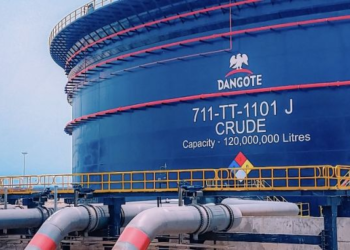
The Nigerian National Petroleum Company Limited (NNPC Ltd) ended 2024 carrying at least ₦8.07 trillion in outstanding obligations tied to crude oil and gas forward-sale agreements, a detailed review of the company’s latest audited financial statements has revealed.
The debts, spread across multiple prepaid financing deals, require the state oil firm to deliver hundreds of thousands of barrels of crude and refined products daily for years to come, effectively mortgaging a significant portion of Nigeria’s future production to service past and present cash shortfalls.
The largest single exposure is the ₦5.1 trillion Project Gazelle facility used primarily to settle advance tax and royalty payments under Production Sharing Contracts. By December 2024, NNPC had drawn ₦4.9 trillion and repaid only ₦991 billion through crude deliveries, leaving ₦3.8 trillion outstanding. The deal locks in 90,000 barrels per day until the balance is cleared.
Refinery rehabilitation programmes account for another heavy burden. Project Yield, the financing package behind the ongoing overhaul of the Port Harcourt Refinery, had ₦1.4 trillion drawn down by year-end. Starting June 2025, NNPC must supply the refined-product equivalent of 67,000 barrels of crude daily for seven years.
Project Leopard, a five-year prepaid facility, carries a ₦1.3 trillion balance and commits 35,000 barrels per day from mid-2025. The remaining tranche of the older Project Eagle arrangement adds another ₦1.1 trillion, secured against 21,000 barrels per day.
Separate from crude, a gas-supply financing deal with Nigeria LNG Limited still requires NNPC to deliver gas worth roughly ₦472 billion after NLNG recovered ₦312 billion of its original ₦772 billion advance.
Taken together, the four main crude-backed facilities alone tie up 213,000 barrels per day well over 10 per cent of Nigeria’s current production capacity for years ahead.
Analysts say the structure has helped NNPC bridge chronic cash-flow gaps, clear legacy FX backlogs, rehabilitate refineries, and meet statutory payments to government without fresh borrowing on conventional terms. However, it also leaves the company highly vulnerable to any drop in output, delays in refinery start-up, or sustained weakness in global oil prices.
The heavy pre-commitments come against a backdrop of weakening fiscal returns from the oil sector. Separate data from the Budget Office show gross profit from crude oil and gas sales crashed 43 per cent to ₦1.08 trillion in 2024, missing budget targets by more than a quarter despite higher production volumes.
With repayment schedules now kicking in across most facilities from mid-2025, industry watchers warn that NNPC’s room to manoeuvre on new upstream investments, dividend payments, or domestic fuel supply obligations, and federation revenue remittances could become severely constrained unless oil production rises sharply or fresh financing sources are secured.