RateCaptain
  • Home
    • About Us
    • Contact Us
  • FX Rates
  • Money Market
  • Cryptocurrency
  • Commodities
  • Corporates
No Result
View All Result
Subscribe
  • Home
    • About Us
    • Contact Us
  • FX Rates
  • Money Market
  • Cryptocurrency
  • Commodities
  • Corporates
No Result
View All Result
RateCaptain
No Result
View All Result
Home News

CBN to maintain tight monetary policy, estimates 12% inflation

Rate Captain by Rate Captain
March 22, 2019
in News
Reading Time: 3 mins read
A A
0
Share on FacebookShare on TwitterShare on WhatsappShare on Telegram

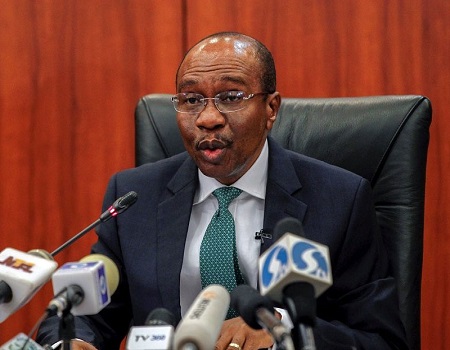
The Governor, Central Bank of Nigeria, Mr Godwin Emefiele, has projected that the current monetary policy stance of the bank is expected to continue while inflation is estimated to rise to 12% and moderate thereafter.

He said this while making a presentation on ‘Setting the agenda for economic growth and business confidence,’ following the conduct of elections in 2019’, at the Businessday post-election economic agenda conference in Lagos on Thursday.

AlsoRead

Canada Names Eight Firms That Can Hire Nigerians Without LMIA 

US Makes Visa Bond of Up to $20,000 Permanent, Keeps Nigeria on Restricted List

How I Lost N200 Billion”: Femi Otedola Reflects on His Biggest Financial Setback


“The CBN has set the post-election agenda for the nation’s monetary policy, projecting that the current monetary policy stance of the bank is expected to continue while inflation is estimated to rise to 12% and moderate thereafter,” he said.

Latest statistics by the CBN and the National Bureau of Statistics put the country’s inflation rate at 11.31% in February.

Emefiele, who hinged the monetary policy stance of the bank on rising inflation expectations, however, noted that the bank would adjust the policy rate in line with unfolding conditions and outlooks.

Like it did in 2018, he said the bank would continue in its drive to ensure that the policy interest rate was set to balance the objectives of price stability with output stabilisation.

While basing the inflationary projection on productivity gains in the agricultural and manufacturing sectors, he said the Gross Domestic Product was expected to pick up in the first half of the current year owing largely to the continued efforts at driving indigenous production in high-impact real sector activities.

On the exchange rate policy, he said the bank, in spite of expected pressures from the volatility in the crude oil markets, would maintain its stable exchange rate over the next year.

“Gross stability is projected in the foreign exchange market, given increased oil production and contained import bill,” he said.

Emefiele expressed optimism that the country’s Balance of Payments would remain positive in the short-term, adding that the current account balance could improve further if oil prices continued to recover.


He said, “This will be supported by improved non-oil performance as diversification efforts begin to yield results to reduce undue imports.”

While warning that the issues that led to the economic crisis between 2015 and 2017 remained visible, Emefiele stressed the need to significantly increase the country’s policy buffers, including fiscal measure, to increase its external reserve.

He also reiterated the need to diversify the revenue structure of the Federal Government, in order to reduce dependence on direct proceeds from the sale of crude oil.

He advised that cheap financing would be provided to boost local production of priority goods in critical sectors of the economy in order to reduce reliance on foreign imports.

While highlighting the efforts made by the CBN in the past five years of its  monetary policy and development finance, he disclosed that the weakening of the Naira impacted the balance sheets of domestic banks.

He said the bank took some measures such as monitoring the financial position and performance of supervised institutions and the assessment of the risk profile and governance management practices of banks to guarantee financial stability.

Emefiele listed other efforts carried out by the bank to ensure financial system stability and the promotion of sustainable economic development to include the establishment of the investors and exporters’ window, conservation of foreign exchange through the restriction of access to foreign exchange on 43 items, and increased lending to the agricultural and manufacturing sectors.

The governor, while soliciting the continued support of policy measures that restricted import of items that could be produced in Nigeria as well as an increased penalty for smuggling of restricted items in Nigeria, expressed optimism that the Nigerian economy in post-May 2019 would witness growth and reduced unemployment.

Tags: The Punch
Previous Post

Manufacturing Slump Deals Another Blow to Europe’s Economic Outlook

Next Post

Nigeria produces 55.85 million tons of solid minerals –NBS

Related News

10,180 Nigerians Immigrates to Canada Within H1 2023, IRCC Data Reveals

Canada Names Eight Firms That Can Hire Nigerians Without LMIA 

by Victoria Attah
August 5, 2026
0

Canada has designated eight high-growth companies authorised to hire eligible foreign professionals, including Nigerians, through a special work-permit pathway that...

US Makes Visa Bond of Up to $20,000 Permanent, Keeps Nigeria on Restricted List

by Victoria Attah
August 3, 2026
0

The United States has made permanent a visa bond programme that allows consular officers to require deposits of up to...

Otedola acquires 5.52% of Transcorp Plc.

How I Lost N200 Billion”: Femi Otedola Reflects on His Biggest Financial Setback

by Rate Captain
August 22, 2025
0

In a rare moment of vulnerability, billionaire businessman Femi Otedola has shared the story of how he lost nearly N200...

EFCC Launches Task Force to Combat Naira Mutilation and Dollarization

EFCC Arraigns Precious Williams for Alleged N13.8 Billion Ponzi Scheme Fraud

by Victoria Attah
June 17, 2025
0

The Economic and Financial Crimes Commission (EFCC) has charged Precious Williams, a director of Glossolalia Nigeria Ltd and Pelegend Nigeria...

Next Post

Nigeria produces 55.85 million tons of solid minerals –NBS

Leave a Reply Cancel reply

Your email address will not be published. Required fields are marked *

Recommended

Nigerian Customs Deactivate Two Banks Over Failure to Remit Duties.

Apapa Customs Posts Record N28.10 Billion Daily Collection

August 20, 2026
Nigeria’s Public Debt Hits N46.25trn In Q4 2022 – NBS

Energy Inflation Falls to 4.37% in July, Lowest Level in Four Months

August 20, 2026

Popular Story

  • Nigeria’s Debt to China Surges by $800 Million in One Year

    31 Nigerian States Grapple with N2.57 Trillion Domestic Debt Amid No Foreign Inflows

    0 shares
    Share 0 Tweet 0
  • Nigeria Anticipates $2.25 Billion World Bank Loan Approval in June

    0 shares
    Share 0 Tweet 0
  • Nigeria State Firm to Be Minority Investor in Largest Refinery

    0 shares
    Share 0 Tweet 0
  • China’s Exports to Nigeria Hit Record $24.9 Billion in 2025, Widening Trade Imbalance

    0 shares
    Share 0 Tweet 0
  • Rising AMCON Expenses Pose Future risk for Nigeria’s Banking System.

    0 shares
    Share 0 Tweet 0

RateCaptain

We bring you the most accurate in new and market data. Check our landing page for details.

  • Home
  • About Us
  • Privacy Policy
  • Terms & Conditions
  • Disclaimer
  • Cookie Policy
  • Contact Us

Copyright © 2022 RateCaptain - All rights reserved by RateCaptain.

No Result
View All Result
  • Home
    • About Us
    • Contact Us
  • FX Rates
  • Money Market
  • Cryptocurrency
  • Commodities
  • Corporates

Copyright © 2022 RateCaptain - All rights reserved by RateCaptain.

RateCaptain
Manage Cookie Consent
To provide the best experiences, we use technologies like cookies to store and/or access device information. Consenting to these technologies will allow us to process data such as browsing behavior or unique IDs on this site. Not consenting or withdrawing consent, may adversely affect certain features and functions.
Functional Always active
The technical storage or access is strictly necessary for the legitimate purpose of enabling the use of a specific service explicitly requested by the subscriber or user, or for the sole purpose of carrying out the transmission of a communication over an electronic communications network.
Preferences
The technical storage or access is necessary for the legitimate purpose of storing preferences that are not requested by the subscriber or user.
Statistics
The technical storage or access that is used exclusively for statistical purposes. The technical storage or access that is used exclusively for anonymous statistical purposes. Without a subpoena, voluntary compliance on the part of your Internet Service Provider, or additional records from a third party, information stored or retrieved for this purpose alone cannot usually be used to identify you.
Marketing
The technical storage or access is required to create user profiles to send advertising, or to track the user on a website or across several websites for similar marketing purposes.
  • Manage options
  • Manage services
  • Manage {vendor_count} vendors
  • Read more about these purposes
View preferences
  • {title}
  • {title}
  • {title}
?>