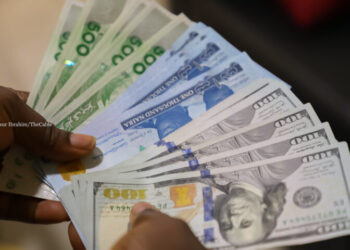
The naira came under renewed pressure in the informal foreign exchange market over the past week, depreciating to N1,490 per dollar on Friday its weakest level so far in 2026 while the official rate held relatively firm, pushing the premium between the two windows to its widest point in 11 months.
According to data compiled by Nairametrics Research and the Central Bank of Nigeria’s (CBN) official market updates for the third trading week of January, the parallel market rate climbed from N1,477 on January 9 to between N1,489 and N1,490 by Friday’s close. This created a gap of N73 against the official Nigerian Autonomous Foreign Exchange Market (NAFEM) rate, which appreciated marginally to N1,417.95 per dollar from N1,424.50 a week earlier.
The N73 spread is the largest recorded since February 2025, when the disparity briefly exceeded N100 during a period of extreme volatility. At that time, the official rate had traded as high as N1,499 while the parallel market touched N1,605, and for a short window later in the month, the official rate even weakened beyond the street rate.
The widening premium comes despite a modest improvement in Nigeria’s external reserves, which rose to $45.8 billion by the end of the week — up from $45.6 billion the previous week. The gradual build-up reflects steady inflows from oil exports and some portfolio investment activity, providing the CBN with a slightly stronger buffer for potential interventions.
However, strong demand for foreign exchange — driven by seasonal needs, corporate obligations, school fees, medical tourism, and small-scale imports — continues to outpace available supply in the informal segment. Bureau de change operators in Abuja and Lagos report that many customers seeking dollars for immediate use are turning to the parallel market due to delays or restrictions in accessing official channels.
Market analysts say the persistent gap signals ongoing strain in Nigeria’s multi-tiered FX system. A widening spread often creates arbitrage opportunities, encourages speculation, and puts upward pressure on the official rate over time. Historically, the CBN has responded to such divergences with direct dollar sales, administrative measures, or tighter enforcement on licensed dealers.
The latest development contrasts with the relative stability seen at the end of 2025, when the parallel rate closed around N1,470 and the official rate at N1,429. That year-end gap had already marked the widest divergence since February 2025, underscoring that FX market pressures have carried into the new year.
For businesses and households, the N73 premium translates to higher costs on imported goods, international education, healthcare abroad, and any transaction routed through the informal market. It also serves as a barometer of confidence in the official FX window.
While reserves above $45 billion offer some reassurance, experts caution that sustained demand-side pressures — combined with limited new foreign inflows — could keep the parallel market elevated unless the CBN steps up interventions or structural reforms boost dollar supply.
As the CBN continues to balance stability with market liberalisation, the coming weeks will test whether the current gap narrows through policy action or widens further under persistent demand. For now, the naira’s street price remains a clear reminder that FX challenges persist despite pockets of improvement in the official window.