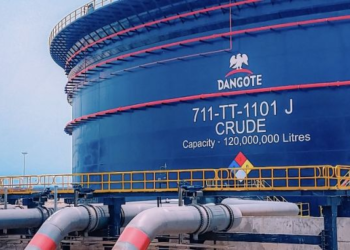
Nigeria consumed 613.62 million litres of Premium Motor Spirit (PMS), commonly known as petrol, from October 2024 to October 10, 2025, with domestic refineries, led by the Dangote Petroleum Refinery, significantly reducing the country’s reliance on imports, according to data from the Nigerian Midstream and Downstream Petroleum Regulatory Authority (NMDPRA).
Shift in Fuel Supply Dynamics
Of the total petrol consumed, imports accounted for 377.54 million litres (63%), while domestic refineries supplied 236.08 million litres (37%). This marks a notable shift, as local production nearly doubled from 9.62 million litres per day in October 2024 to 18.93 million litres per day by October 2025. Meanwhile, petrol imports plummeted by 67%, dropping from 46.38 million litres per day in October 2024 to 15.11 million litres per day in October 2025.
Monthly data highlights a consistent decline in imports, from 46.38 million litres in October 2024 to 36.39 million in November, 38.90 million in December, and a low of 15.11 million in October 2025. Imports saw temporary spikes, such as 37.37 million litres in May 2025, but the overall trend reflects a reduced dependence on foreign fuel. Conversely, domestic output grew steadily, rising from 9.62 million litres in October 2024 to a peak of 22.66 million litres in January 2025, stabilizing at 18.93 million litres by October 2025.
Dangote Refinery’s Impact
The Dangote Petroleum Refinery, with a capacity of 650,000 barrels per day, has been instrumental in this transformation. Since beginning large-scale production in 2025, it now contributes 15–20 million litres of PMS daily, reshaping Nigeria’s fuel supply landscape. This progress follows decades of underperformance by state-owned refineries in Port Harcourt, Warri, and Kaduna, positioning Dangote as a cornerstone of the country’s industrial and energy strategy.
Economic and Strategic Benefits
The rise in domestic refining has alleviated pressure on Nigeria’s foreign exchange reserves, previously strained by billions spent monthly on fuel imports, including costs for letters of credit, freight, and insurance. The shift toward local production is seen as a boost to economic stability and a step toward energy self-sufficiency. However, challenges such as logistical bottlenecks and periodic maintenance have led to fluctuations in total supply, which dropped from 55.21 million litres in May 2025 to 34.04 million litres in October 2025.
Looking Ahead
The NMDPRA data underscores a pivotal moment for Nigeria’s energy sector, with domestic refineries closing the gap on imports within a single year. Analysts note that continued improvements in refining capacity and distribution infrastructure will be critical to sustaining this trend, reducing import costs, and enhancing energy security. The Dangote Refinery’s performance continues to draw global attention, signaling Nigeria’s potential to lead in regional fuel production.