RateCaptain
  • Home
    • About Us
    • Contact Us
  • FX Rates
  • Money Market
  • Cryptocurrency
  • Commodities
  • Corporates
No Result
View All Result
Subscribe
  • Home
    • About Us
    • Contact Us
  • FX Rates
  • Money Market
  • Cryptocurrency
  • Commodities
  • Corporates
No Result
View All Result
RateCaptain
No Result
View All Result
Home Economy

An overview of Nigeria’s foreign reserves under Godwin Emefiele’s leadership as the CBN governor.

Rate Captain by Rate Captain
April 20, 2023
in Economy
Reading Time: 2 mins read
A A
0
An overview of Nigeria’s foreign reserves under Godwin Emefiele’s leadership as the CBN governor.
Share on FacebookShare on TwitterShare on WhatsappShare on Telegram

Since Godwin Emefiele’s appointment as the Central Bank Governor of Nigeria in 2014, the country’s foreign reserves have experienced significant fluctuations. Nigeria’s foreign reserves refer to the amount of foreign currency held by the Central Bank of Nigeria (CBN) to facilitate international trade transactions and manage the exchange rate.
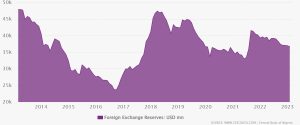
Nigeria’s foreign exchange reserve from 2014 till 2023

At the beginning of Emefiele’s tenure, Nigeria’s foreign reserves stood at $37.9 billion, a significant decrease from the $44.3 billion recorded in 2013. This decline was largely attributed to the drop in global oil prices, capital outflows, and rising interest rates in the United States.

AlsoRead

IMF Refuses to Endorse External or Domestic Borrowing for Nigeria.

FG Introduces Green Tax on High-Engine Vehicles from July 1 to Promote Cleaner Transport

Naira Hits Strongest Level Since Mid-February as Global Dollar Weakens

However, in the following years, the country’s foreign reserves began to gradually increase due to various policies, such as the Anchor Borrowers’ Programme and other policies that encourage the exportation of non-oil products, implemented by the CBN under Emefiele’s leadership. In 2018, Nigeria’s foreign reserves hit a four-year high of $43.1 billion, a significant increase from the $29.1 billion recorded in 2015.

One of the major policies implemented by the CBN was the introduction of a flexible exchange rate regime, which was aimed at reducing the pressure on the country’s foreign reserves. The flexible exchange rate regime allowed market forces to determine the exchange rate of the naira, Nigeria’s currency, against other currencies. This policy helped attract foreign investment and increased the country’s foreign exchange earnings.

In addition, the CBN implemented various interventions to support key economic sectors, such as agriculture, manufacturing, and the RT200 rebate scheme, in order to build the foreign reserve. These interventions were aimed at reducing the country’s reliance on imports, thereby conserving foreign exchange reserves.

However, despite the various policies implemented by the CBN, Nigeria’s foreign reserves have experienced significant fluctuations in recent years. In 2020, the country’s foreign reserves declined to $35.4 billion, a decrease from the $43 billion recorded at the beginning of the year in 2019. This decline was largely attributed to the COVID-19 pandemic, which led to a drop in global oil prices and a decrease in the country’s foreign exchange earnings.

As of April 2023, Nigeria’s foreign reserve stood at $35.4 billion. This is a significant increase from the $34.8 billion reported in April 2021. The country’s foreign reserve has been on an upward trend since the end of 2021, with consistent growth over the past two years.

In conclusion, while Nigeria’s foreign reserves have experienced significant fluctuations since Godwin Emefiele’s appointment as the CBN governor in 2014, the various policies implemented by the CBN have helped to increase the country’s foreign reserves over the years. However, there is a need for sustained efforts to diversify the country’s economy away from oil and increase foreign exchange earnings from other sectors.

Tags: #agriculture#AnchorBorrowersProgramme#CentralBankofNigeria#COVID19#economicdiversification#economicinterventions#flexibleexchangerate#foreignexchangeearnings#foreignreserves#GodwinEmefiele#manufacturing#Nigeria#nonoilproducts#oilprices#RT200rebatescheme
Previous Post

Microsoft Drops Twitter from Advertising Platform After Twitter’s New Pricing Scheme

Next Post

Accelerex wins prestigious Excellence in Commerce Enablement Award at Africa Fintech Summit 2023.

Related News

IMF Applauds Tinubu Policy Reforms While Lowering Growth Projections

IMF Refuses to Endorse External or Domestic Borrowing for Nigeria.

by Victoria Attah
April 17, 2026
0

The International Monetary Fund (IMF) has declined to recommend whether Nigeria should prioritise external or domestic borrowing, insisting instead that...

Top 6 innovative industries to watch in the Next 5 Years

FG Introduces Green Tax on High-Engine Vehicles from July 1 to Promote Cleaner Transport

by Jide Omodele
April 17, 2026
0

The Federal Government has rolled out a new environmental levy targeting vehicles with large engine capacities as part of the...

Battered Commodity Currencies Gain Attention Amid Dollar’s Decline.

Naira Hits Strongest Level Since Mid-February as Global Dollar Weakens

by Stephen Akudike
April 16, 2026
0

The Nigerian naira extended its recent rally on Wednesday, closing at N1,341.99 per US dollar in the official foreign exchange...

Nigerian Airlines Issue Ultimatum: “We May Shut Down Operations Over N3,000/Litre Jet Fuel”

by Victoria Attah
April 16, 2026
0

Nigerian airlines have issued a dramatic ultimatum, warning that they may suspend all domestic and international flight operations nationwide from...

Next Post
Accelerex wins prestigious Excellence in Commerce Enablement Award at Africa Fintech Summit 2023.

Accelerex wins prestigious Excellence in Commerce Enablement Award at Africa Fintech Summit 2023.

Leave a Reply Cancel reply

Your email address will not be published. Required fields are marked *

Recommended

Nigerian Breweries Reports Record N145 Billion Naira Loss in 2023

Nigerian Breweries Attributes 135% Share Price Surge to Successful Recovery Strategy

April 17, 2026
Nigeria Rules Out IMF Loans Despite Rising Debt Concerns – Wale Edun

Nigeria Rules Out IMF Loans Despite Rising Debt Concerns – Wale Edun

April 17, 2026

Popular Story

  • 2024 Budget Outline: Oil Price Set at $77.96, Naira Stands at 750 Against the Dollar

    FG Takes Governors to Supreme Court Over Local Government Allocations

    0 shares
    Share 0 Tweet 0
  • External debt servicing gulps $357.26m in three months

    0 shares
    Share 0 Tweet 0
  • Nigeria Total Debt Surges to N88 Trillion – DMO

    0 shares
    Share 0 Tweet 0
  • Nigerian Breweries Attributes 135% Share Price Surge to Successful Recovery Strategy

    0 shares
    Share 0 Tweet 0
  • Nigerian Airlines Issue Ultimatum: “We May Shut Down Operations Over N3,000/Litre Jet Fuel”

    0 shares
    Share 0 Tweet 0

RateCaptain

We bring you the most accurate in new and market data. Check our landing page for details.

  • Home
  • About Us
  • Privacy Policy
  • Terms & Conditions
  • Disclaimer
  • Cookie Policy
  • Contact Us

Copyright © 2022 RateCaptain - All rights reserved by RateCaptain.

No Result
View All Result
  • Home
    • About Us
    • Contact Us
  • FX Rates
  • Money Market
  • Cryptocurrency
  • Commodities
  • Corporates

Copyright © 2022 RateCaptain - All rights reserved by RateCaptain.

RateCaptain
Manage Cookie Consent
To provide the best experiences, we use technologies like cookies to store and/or access device information. Consenting to these technologies will allow us to process data such as browsing behavior or unique IDs on this site. Not consenting or withdrawing consent, may adversely affect certain features and functions.
Functional Always active
The technical storage or access is strictly necessary for the legitimate purpose of enabling the use of a specific service explicitly requested by the subscriber or user, or for the sole purpose of carrying out the transmission of a communication over an electronic communications network.
Preferences
The technical storage or access is necessary for the legitimate purpose of storing preferences that are not requested by the subscriber or user.
Statistics
The technical storage or access that is used exclusively for statistical purposes. The technical storage or access that is used exclusively for anonymous statistical purposes. Without a subpoena, voluntary compliance on the part of your Internet Service Provider, or additional records from a third party, information stored or retrieved for this purpose alone cannot usually be used to identify you.
Marketing
The technical storage or access is required to create user profiles to send advertising, or to track the user on a website or across several websites for similar marketing purposes.
  • Manage options
  • Manage services
  • Manage {vendor_count} vendors
  • Read more about these purposes
View preferences
  • {title}
  • {title}
  • {title}
?>