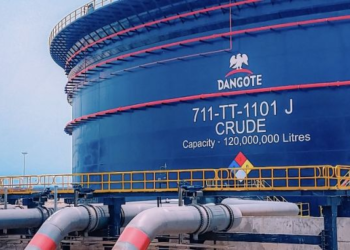
Nigeria’s domestic refineries processed 683,000 barrels of crude oil per day in August 2026, a 16.75 per cent increase from 585,000 barrels per day in July. The rise coincided with a substantial increase in petrol supply from the Dangote Refinery and a marked decline in fuel imports, according to the Nigerian Midstream and Downstream Petroleum Regulatory Authority.
The Dangote Refinery raised its daily petrol deliveries to the local market by 39 per cent to 35.9 million litres. At the same time, national petrol imports fell 26 per cent to 14.6 million litres per day. The figures are contained in the NMDPRA’s August 2026 Midstream and Downstream Sector Factsheet, which also noted higher overall crude availability for local refining.
Higher Domestic Receipts, Lower Import Dependence
Average daily petrol receipts across the country climbed 11 per cent to 50.5 million litres per day in August, up from 45.5 million litres in July. Domestic production supplied 35.9 million litres per day of that total, compared with 25.8 million litres the previous month. Petrol imports contracted from 19.7 million litres per day in July to 14.6 million litres in August.
Diesel imports recorded an even steeper decline, falling from 7.9 million litres per day to 1.3 million litres. Liquefied petroleum gas imports, by contrast, rose from 0.9 million litres per day to 1.3 million litres.
Dangote Refinery Performance
The Dangote facility operated at an average capacity utilisation of 105.21 per cent in August. It produced 41.94 million litres of Premium Motor Spirit (petrol) per day, 18.01 million litres of diesel and 24.48 million litres of aviation fuel.
Of its petrol output, 35.87 million litres went to the Nigerian market while 9.73 million litres were exported. Diesel deliveries to the domestic market stood at 12.37 million litres per day, with 8.75 million litres exported. Aviation fuel showed a stronger export bias: 3.07 million litres were supplied locally against 21.30 million litres exported.
At the end of August the refinery held stocks of 360.4 million litres of petrol, 137.2 million litres of diesel and 133.3 million litres of aviation fuel.
Market Implications
The data indicate that the Dangote Refinery increased its contribution to domestic petrol supply in August, helping to reduce Nigeria’s reliance on imported fuel. A lower import volume could ease demand for foreign exchange used to pay for cargoes. Pump prices, however, will continue to be influenced by other factors, including international crude prices—Brent was reported at about $107 per barrel in a related market update—and domestic distribution costs.