Nigeria’s financial markets faced a turbulent start to November 2025, with the naira and stock market experiencing significant declines following provocative statements from U.S. President Donald Trump. During a speech at the Asia-Pacific Economic Cooperation (APEC) CEO Summit in Gyeongju, South Korea, on October 29, 2025, Trump raised concerns about alleged religious persecution in Nigeria, hinting at potential U.S. military action.
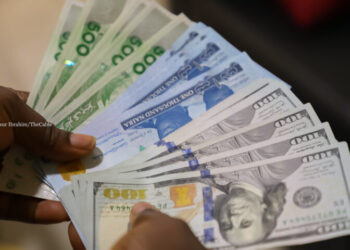
According to Central Bank of Nigeria data, the naira fell 1.03% to N1,436.34/$ on Monday, down from its 2025 high of N1,421.73/$, losing N14.61 in a single day. The parallel market saw similar pressure, with the naira dropping to N1,455/$. The depreciation was driven by heightened investor unease and increased demand for foreign currency, triggered by Trump’s comments on Truth Social, where he labeled Nigeria a “country of particular concern” and instructed the U.S. Department of War to prepare for possible intervention over alleged “Christian genocide.”
The remarks sparked a swift reaction in Nigeria’s financial markets. The Nigerian Exchange Limited (NGX) saw its All-Share Index decline by 0.25% to 153,739.11 points, reducing year-to-date gains to 49.37%. Market capitalization dropped by N245.88 billion, closing at N97.58 trillion. Heavy sell-offs in stocks like Aradel Holdings (-9.21%) and Access Corporation (-3.07%) fueled the downturn. Market sentiment remained bearish, with 38 stocks losing value compared to 19 gainers. Union Dicon led gainers with a 9.93% rise, while Honeywell Flour Mills was the biggest loser, down 10%.
Trading activity also contracted significantly, with volume and value traded falling 87.94% and 44.64%, respectively, to 627.5 million units worth N25 billion. United Bank for Africa was the most traded stock, accounting for 21.8% of volume and 22.2% of value.
Sector performance was uneven, with declines in Oil & Gas (-3.94%), Commodities (-1.85%), Insurance (-1.48%), and Banking (-0.22%), while Consumer Goods edged up by 0.49%. The Industrial sector remained unchanged. In the bond market, Nigeria’s Eurobonds saw reduced demand, with average yields rising 5 basis points to 7.70%, reflecting global risk aversion and geopolitical uncertainty, according to Cowry Assets Management. Bloomberg reported that Nigeria’s dollar-denominated bonds, particularly those maturing in 2047, were among the worst performers in emerging markets, dropping 0.6 cents to 88.26 cents before recovering slightly.
Analysts offered mixed perspectives on the market’s reaction. Tilewa Adebajo, CEO of CFG Advisory, described the downturn as a temporary setback, noting early signs of recovery in global markets and Nigeria’s recent removal from the FATF Grey List as a positive signal for long-term stability. Conversely, Dr. Musa Yusuf, CEO of the Centre for the Promotion of Private Enterprise, cautioned that Trump’s remarks could erode investor confidence, labeling the threat of military action as “unwarranted and destabilizing.” Yusuf emphasized the need for diplomatic engagement over coercive measures, warning that unilateral actions could harm Nigeria’s economy and regional stability.
As Nigeria navigates this period of uncertainty, analysts stress the importance of steady macroeconomic policies and diplomatic efforts to restore market confidence and ensure stability.