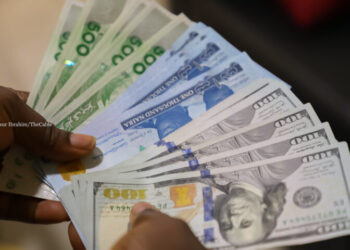
The naira traded at N1,400 to the dollar in the parallel market on Friday, softening by N3 from the N1,397 recorded at Thursday’s close. At the same time, foreign exchange turnover at the official Nigerian Foreign Exchange Market window climbed to $1.06 billion. The gap between the official and parallel rates widened to 4.63 per cent on Friday from 4.41 per cent on Thursday.
Official Market and Reserves
In the official market, the naira reached a five-month high of N1,338.59 on Thursday, strengthening by N5 from the N1,343.59 quoted on Wednesday at the Nigerian Foreign Exchange Market.
Nigeria’s external reserves, which give the Central Bank of Nigeria capacity to support the currency, rose to an 18-year high of $53.31 billion as of August 27, 2026. That represents a 29.27 per cent increase from the $41.24 billion recorded in the corresponding period of 2025.
Central Bank data also showed that total turnover at the official window increased 16.43 per cent to $1.06 billion on Thursday from $913.76 million on Wednesday. The number of deals, however, fell 11.27 per cent to 425 from 479.
Sectoral Foreign Exchange Use
According to the Central Bank’s Quarterly Statistical Bulletin, foreign exchange utilisation across economic sectors rose sharply by 74 per cent year-on-year to $16.2 billion in the first quarter of 2026. Analysts at Quest Merchant Bank Limited said the increase was broad-based but driven mainly by invisible transactions, which more than doubled to $11.4 billion from $4.5 billion and accounted for about 70 per cent of total utilisation.
Within the invisible segment, the financial services sector was the largest user. Its foreign exchange utilisation climbed 117 per cent year-on-year to $9.0 billion, representing roughly 79 per cent of all invisible transactions. Business services, the second-largest category, saw utilisation jump to $1.2 billion from $223.6 million.
Visible or merchandise imports remained broadly stable, rising 0.2 per cent to $4.9 billion. Industrial firms, which rely heavily on imported raw materials and machinery, recorded a 20 per cent decline in utilisation to $1.8 billion. Imports of manufactured products and transport products, by contrast, rose sharply to $1.1 billion and $295.0 million respectively from $477.9 million and $142.8 million. The increases partly reflected higher import costs linked to global supply-chain disruptions and elevated prices of critical inputs following the US-Iran conflict.
Implications for the Currency
The rise in sectoral foreign exchange utilisation points to improved liquidity in the economy, underpinned by stronger external reserves. Sustained availability of foreign exchange has helped keep the naira relatively stable, supporting market confidence and encouraging demand from end-users through greater predictability.
Looking ahead, analysts at Quest Merchant Bank said: “We expect stronger FX utilisation across sectors, supported by the CBN’s ongoing reforms and policy measures aimed at sustaining FX supply, deepening market liquidity and preserving confidence in the naira.”