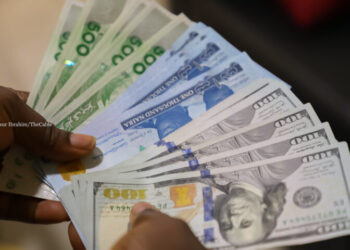
Turnover on the Nigerian Foreign Exchange Market declined 17.7 per cent week-on-week to $2.25 billion in the week ended 25 September 2026, marking a second consecutive weekly fall.
Central Bank of Nigeria data showed activity slipped from $2.74 billion in the preceding week, even as the naira held relatively steady near N1,330 per dollar. The slowdown occurred in the same week the apex bank reduced its Monetary Policy Rate by 350 basis points to 23 per cent from 26.5 per cent.
Second Straight Weekly Decline
Market turnover has now retreated for two successive weeks after stronger levels earlier in September. Activity reached $3.16 billion in the week ended 18 September before easing to the latest $2.25 billion figure.
Daily volumes varied markedly during the period. The highest single-day turnover was recorded on 15 September at $777.58 million. The lowest reported session was 21 September at $335.51 million, followed by $694.58 million on 22 September. Turnover stood at $732.45 million on 23 September and $492.11 million on 24 September. Full NFEM figures for Friday 25 September had not been released at the time of reporting, although interbank transactions that day amounted to $111.06 million.
Despite the recent weekly softening, cumulative NFEM turnover from 1 to 25 September already totalled approximately $13.58 billion exceeding the $12.54 billion recorded for the whole of August.
Naira Remains Steady Near N1,330
The naira traded in a narrow band throughout the week, moving between N1,325 and N1,336 per dollar. It closed at N1,330 per dollar on 25 September, compared with N1,329 at the end of the previous week.
The weighted average rate also showed limited movement, shifting from N1,329.80 per dollar on 21 September to N1,329.51 on 25 September after briefly easing to N1,327.78 on 22 September. The relative stability was underpinned by improved foreign-exchange liquidity and rising external reserves.
Reserves Top $55 Billion Amid Policy Easing
Nigeria’s external reserves crossed the $55 billion mark, reaching their highest level in more than 18 years. The stronger reserve position and healthier FX liquidity formed part of the backdrop to the Central Bank’s decision to ease monetary policy.
The 350-basis-point cut to 23 per cent was announced after the 307th Monetary Policy Committee meeting held on 21–22 September. The reduction followed several successive meetings in which the rate had been held at 26.5 per cent. The move also coincided with a modest easing in headline inflation, which moderated to 15.39 per cent in August 2026 from 15.43 per cent in July, according to the National Bureau of Statistics.