RateCaptain
  • Home
    • About Us
    • Contact Us
  • FX Rates
  • Money Market
  • Cryptocurrency
  • Commodities
  • Corporates
No Result
View All Result
Subscribe
  • Home
    • About Us
    • Contact Us
  • FX Rates
  • Money Market
  • Cryptocurrency
  • Commodities
  • Corporates
No Result
View All Result
RateCaptain
No Result
View All Result
Home Economy

Nigeria Still Imports 1.3 Billion Litres of Petrol in December Despite Dangote’s Growing Output

Stephen Akudike by Stephen Akudike
January 16, 2026
in Economy
Reading Time: 2 mins read
A A
0
Petrol Prices Surge in West Africa as Nigeria Removes Subsidies.
Share on FacebookShare on TwitterShare on WhatsappShare on Telegram

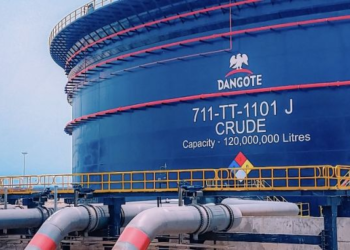
Nigeria imported around 1.31 billion litres of petrol in December 2025, even as the Dangote Petroleum Refinery ramped up its domestic supply to nearly 1 billion litres during the same month, according to the latest data from the Nigerian Midstream and Downstream Petroleum Regulatory Authority (NMDPRA).

The figures highlight the persistent gap between rising local production and national demand, particularly during the high-consumption Yuletide period. Total petrol supply reached 2.3 billion litres in December — up from 2.15 billion litres in November — with average daily availability climbing to 74.2 million litres per day. Imports accounted for 42.2 million litres daily, while Dangote contributed 32 million litres per day.

AlsoRead

Naira Breaks Below N1,400 as Oil Rally and CBN Reforms Fuel Fresh Stability

Larger Disparities Boom Between Black Market and Official Rates

Emefiele’s Naira Redesign Memo Takes Centre Stage in EFCC Trial

In contrast, November saw imports dominate at 1.57 billion litres (52.1 million litres per day), with Dangote supplying just 585 million litres (19.5 million litres per day). The NMDPRA attributed the high November import volumes to shortages in September and October 2025, when domestic output fell short of demand.

The Dangote refinery has steadily increased its market share since commencing petrol production in September 2024. In the second half of 2025, it consistently delivered over 50 million litres per day — and on some days more than 52 million litres — even while still ramping up certain units. On Wednesday, Managing Director David Bird announced that the facility has transitioned to full 24-hour operations, including night-time loading, to improve evacuation efficiency and handle over 1,000 trucks daily.

“We’re already doing nighttime loading. It’s a 24-hour operation,” Bird said during a press briefing at the Lekki complex. “We have celebrated over 50 million litres of offtake, which means over a thousand trucks progressing through the gate and gantry.”

Despite the refinery’s progress, imports remain substantial, prompting renewed criticism from Aliko Dangote. The industrialist has accused the former NMDPRA leadership of issuing “reckless licences” that undermine local production. He claimed the authority approved licences for about 7.5 billion litres of imports in the first quarter of 2026, even though the refinery has guaranteed sufficient supply.

To counter the import flood, Dangote slashed its ex-depot petrol price in December, dropping from around N900 to N739 per litre (with a gantry price of N699 per litre). The move, made at a loss to the refinery, aimed to keep pump prices affordable during the festive season and discourage reliance on imported fuel.

The price war has squeezed importers. According to the Major Energies Marketers Association of Nigeria (MEMAN), the landing cost of imported petrol fluctuated between N750 and N780 per litre in recent weeks — significantly higher than Dangote’s N699 ex-depot price — making it difficult for imported volumes to compete at filling stations, especially those supplied by MRS (which sources from Dangote).

The NMDPRA has defended the import licences, insisting they were necessary to bridge earlier supply gaps. However, with Dangote now operating at scale and expanding loading capacity, the balance is shifting toward greater domestic reliance.

For millions of Nigerians, the December numbers offer a mixed picture: more local petrol is reaching the market, prices have stabilised somewhat, but the country still depends heavily on imports — even as Africa’s largest refinery continues to prove its ability to meet a growing share of national demand. The coming months will test whether sustained 24-hour production and competitive pricing can finally tip the scales decisively in favour of made-in-Nigeria fuel.
Tags: #Nigeria
Previous Post

Nigeria Inflation Drops to 15.15% in December 2025

Next Post

EU Delists Nigeria from High-Risk Jurisdictions for Money Laundering and Terrorism Financing

Related News

Angola Surpasses Nigeria, Becomes Africa’s Largest Oil Producer in August

Naira Breaks Below N1,400 as Oil Rally and CBN Reforms Fuel Fresh Stability

by Akpan Edidong
February 5, 2026
0

Nigeria’s naira has strengthened markedly in the official foreign exchange market, closing January at N1,386.55 per US dollar  its firmest...

Naira Surges Against US Dollar, Falls Below N1,000 Mark

Larger Disparities Boom Between Black Market and Official Rates

by Stephen Akudike
February 5, 2026
0

The gap between Nigeria’s official and parallel (black market) exchange rates has widened to over 6%, reviving fears of renewed...

U.S. Steps In on Emefiele Trial, Alleges Human Rights Violations

Emefiele’s Naira Redesign Memo Takes Centre Stage in EFCC Trial

by Victoria Attah
February 5, 2026
0

A 2022 memo from former Central Bank of Nigeria (CBN) Governor Godwin Emefiele seeking presidential approval for the controversial naira...

FG Allocates N5.1 Billion for Presidential Yacht and N5.5 Billion For Student Loans

Government Securities Now 11% of Nigerian Banks’ Assets as Credit Growth Lags

by Stephen Akudike
February 4, 2026
0

Nigerian banks’ exposure to government securities has risen sharply in recent years, now accounting for approximately 11% of their total...

Next Post
GDP in Euro Area Declines by 0.1%, While EU Records a Modest 0.1% Increase

EU Delists Nigeria from High-Risk Jurisdictions for Money Laundering and Terrorism Financing

Leave a Reply Cancel reply

Your email address will not be published. Required fields are marked *

Recommended

Angola Surpasses Nigeria, Becomes Africa’s Largest Oil Producer in August

Naira Breaks Below N1,400 as Oil Rally and CBN Reforms Fuel Fresh Stability

February 5, 2026
Naira Surges Against US Dollar, Falls Below N1,000 Mark

Larger Disparities Boom Between Black Market and Official Rates

February 5, 2026

Popular Story

  • Zenith Bank Appoints Ebenezer Onyeagwu GMD/CEO

    0 shares
    Share 0 Tweet 0
  • Telecoms sector Q1 revenue hits N2tr

    0 shares
    Share 0 Tweet 0
  • India Raises Interest Rates For First Time In Four Years

    0 shares
    Share 0 Tweet 0
  • Capital And Its Reward

    0 shares
    Share 0 Tweet 0
  • Court Gives Access Bank Nod to Take over Etiebet’s Place

    0 shares
    Share 0 Tweet 0
RateCaptain

RateCaptain

We bring you the most accurate in new and market data. Check our landing page for details.

  • Home
  • About Us
  • Privacy Policy
  • Terms & Conditions
  • Disclaimer
  • Cookie Policy
  • Contact Us

Copyright © 2022 RateCaptain - All rights reserved by RateCaptain.

No Result
View All Result
  • Home
    • About Us
    • Contact Us
  • FX Rates
  • Money Market
  • Cryptocurrency
  • Commodities
  • Corporates

Copyright © 2022 RateCaptain - All rights reserved by RateCaptain.

RateCaptain
Manage Cookie Consent
To provide the best experiences, we use technologies like cookies to store and/or access device information. Consenting to these technologies will allow us to process data such as browsing behavior or unique IDs on this site. Not consenting or withdrawing consent, may adversely affect certain features and functions.
Functional Always active
The technical storage or access is strictly necessary for the legitimate purpose of enabling the use of a specific service explicitly requested by the subscriber or user, or for the sole purpose of carrying out the transmission of a communication over an electronic communications network.
Preferences
The technical storage or access is necessary for the legitimate purpose of storing preferences that are not requested by the subscriber or user.
Statistics
The technical storage or access that is used exclusively for statistical purposes. The technical storage or access that is used exclusively for anonymous statistical purposes. Without a subpoena, voluntary compliance on the part of your Internet Service Provider, or additional records from a third party, information stored or retrieved for this purpose alone cannot usually be used to identify you.
Marketing
The technical storage or access is required to create user profiles to send advertising, or to track the user on a website or across several websites for similar marketing purposes.
  • Manage options
  • Manage services
  • Manage {vendor_count} vendors
  • Read more about these purposes
View preferences
  • {title}
  • {title}
  • {title}
?>